Showing posts with label longevity. Show all posts

24 July 2020

What makes for a long life?

Rob Robinson writes:

I am sometimes asked the question: “How long do birds live?” The answer is, as to many good
questions, “It depends”.

The oldest known wild bird is a Laysan Albatross called Wisdom who breeds on the very remote Midway Atoll in the Pacific Ocean and is around 70 years old. The oldest known bird in Britain is a Manx Shearwater from the island of Bardsey in north Wales that was over 50 years old when last seen back in 2008 (more on that in a bit). The reason we know this, of course, is because both of  these birds have been ringed, so we can follow them as individuals. In fact our shearwater outlasted both the original ring and its replacement, so was on its third ring when last caught!

Manx Shearwater. Photo by Lee Barber

Not all birds live so long, clearly; the longest-lived Blue Tit, by comparison, was last seen a few months short of his 10th hatchday. The graph below shows the longevity for each species ringed in Britain and Ireland. But measuring longevity in this way is tricky; to get an accurate figure we  generally) have to catch the bird to fit a ring in the year it was hatched, and then the individual has to be found shortly after it, sadly, dies (these are marked by squares in the figure). This happens rather rarely – Carrion Crow (at 21 years) is one example, but you can see there are relatively few other squares on the graph. More commonly, we catch the bird as an adult so don’t know when it was hatched (the downward-pointing triangles), or the individual is caught/seen before it dies (the upward-pointing triangles), or, sometimes, both (the diamonds on the graph). So the Manx Shearwater was first caught in 1957 as an adult (so at least five years old already, possibly more) and then seen every few years until its last capture in 2008, but we don’t know when it died; we only ‘knew’ it for part of its life.

The oldest ever Manx Shearwater, then, is (was or will be) certainly in their late 50s and possibly into their 60s. This highlights another issue with longevities, these individuals are, by their very nature, exceptional, and so few and far between (think how many people live beyond 100, for example). We also have to wait, sometimes for many years, before we can get a fair estimate. Goosander on the graph is a good example: we know the age of HW37685 fairly well, he was ringed as a nestling, and we know when he died (aged 9 ½), but only 10 or 20 goosanders are ringed each year, so the chances of someone ringing (and then finding) the oldest, or even close to the oldest, bird are pretty slim.

Fortunately, we have a better way of measuring longevity, through a measure known as annual survival, which is simply the proportion of individuals that make it from one year to the next; it is the flip-side of mortality. As the graph shows, and one should expect, there is a strong relationship between annual survival and overall longevity.


Species that tend to live longer have higher annual survival rates. Points are coloured by body size and the shape indicates whether the longevity of the individual is fully known. Squares represent a bird ringed as a nestling/juvenile and subsequently found dead. Pointed shapes indicate uncertainty in age, either at the beginning (downward-pointing) or end (upward-pointing) of the bird’s life.

While a few Blue Tits can live as long as 10 years, most do not. In fact, our ringing data show that the annual survival rate of an adult is 0.53. This means that for every 100 adult Blue Tits starting the year, 53 will make it to the end or, conversely, that 47 of them will die at some point during the year. It is worth just stopping for a second and reflecting on what this means out there in our gardens and woods. At last count, there were approximately 3.4 million breeding pairs of Blue Tits in Britain, so 7 million individuals, near enough. A survival rate of 0.53 implies that, in the normal course of things, around 9,000 Blue Tits die, on average, each day (7 million * 0.47 / 365); that’s about three in each and every 10 km square every day. Adding in young birds will, of course, make this figure much higher in the summer. The balance of productivity and survival is important then, since each of these birds needs to be ‘replaced’ if the population is to remain stable in size.

An alternative way of expressing survival is life-expectancy. In the Scottish play, Shakespeare reckoned on living “threescore and ten”, i.e. 70 years (a figure that, in fact, dates back to biblical times, although recently is more like 80 years in developed western countries but nearer 50 years in countries like Afghanistan and Somalia). Broadly, life expectancy in birds varies by size - heavier birds, marked by darker colours, fall more on the right side of the graph, lighter birds, in both colour and mass, to the left. Most small birds, like the Goldcrest, that fledge will not survive to breed. That is, their life-expectancy is less than one year; being a young bird is hazardous indeed! At the other end of the scale, Mute Swan cygnets have a reasonable expectation of making it into their early teens.

The graph shows how most birds cluster about an average line; as survival increases so does the recorded longevity. (The line curves sharply upwards on the right simply because, numerically, survival cannot be greater than 1.) Species that fall well below the line (like Lesser Spotted Woodpecker and Capercaillie) are ringed in such small numbers that we simply don’t have a good estimate of their total longevity yet; in future years these points should rise to become closer to the line. All the conservation effort that has been put into looking after Red Kites, probably means the longevity of that species is a bit higher than it might have otherwise have been. For Wigeon, on the other hand, the annual survival is much lower than we might expect from their longevity because they are hunted over much of their range, the point is well to the left of where it might otherwise be. This leads us on to the main reason why knowing about survival rates is interesting, and why ringing individuals is such a powerful tool.

By measuring how survival varies in different places or times we can understand how and why populations change. By and large, adult survival usually does not vary very much – we find it is pretty consistent between places and over time. When it does change though, the effects can be dramatic. The decline of the Lapwing (see figure) was caused, in large part, by a run of cold winters that made it hard for birds to find food. The population hasn’t recovered, though, not because survival rates have stayed low (they bounced back), but rather because the number of chicks that can be produced in Britain’s intensively managed landscapes was too low to replace those that succumbed. Similarly, the population of Oystercatchers on the Wash (and elsewhere) is sensitive to reduced survival caused by over-harvesting of cockles and mussels, a fact which is now taken into account in managing the shellfisheries there. More often though, it is the balance of survival and productivity that is key, as we see in the decline of Willow Warblers in England and understanding this balance is key to designing effective conservation measures.

Survival of lapwing (purple dots, with 95% confidence limits) was reduced during a period with cold winters (blue arrows) causing a decline in the breeding population (green line, shading indicates 95% limits) in the 1980s. Redrawn from Robinson et al. (2014).

So. What does make for a long life? Certainly if you are a bird being larger helps, and the ringing report shows that all the longest-lived birds are seabirds. But what I hope I have shown is that while the longest-lived individuals are interesting, ringing tells us more about how well the average individual does, and this is why the efforts of ringers are still important. Although tracking studies are producing fascinating new insights virtually every week, the number of birds tagged (or likely to be tagged in the near future) will generally not be sufficient to help us measure survival of birds across the population. Ringing remains the only way to do this, and will continue to be a vital tool in understanding and managing our bird populations for years to come.

If you find a dead bird with a ring on, even one that has hit a window or been brought in by your cat, then you too can contribute to our monitoring of survival. Please tell us by filling out the details at www.ring.ac. There is more information on where birds go, what happens to them and how many birds are ringed in each county on our online ringing and nest recording reports.

08 June 2018

A big jump in Hawfinch Longevity

With the influx of Hawfinch into southern Britain this winter, Jerry Lewis started one of his feeding sites much earlier than usual (in mid January) hoping to try and catch some of the visitors. Despite a decent sized flock of 40+ birds visiting the feeding site, they were mainly coming down to Hornbeam seed, rather than sunflower seeds. After two months, catching had been very slow (just 16 birds caught, at a rate of one every three hours), but after mid March it started to pick up. The largest catches began from mid-April onwards (as happens most years), averaging a 'finger numbing' two birds per hour. 

Despite problems at two of the feeding sites - sunflower seeds being taken by squirrels/wild boar (leaving few for the birds) and a road closure preventing access to a third site, it was Jerry's most successful year to date. By the time his 'catching season' was over he had caught 202 birds, which included 43 that had been ringed in previous years (plus a small number of same-season recaptures). It is unlikely that many (any) would have been continental birds, as migrants had generally left by early April in previous years.

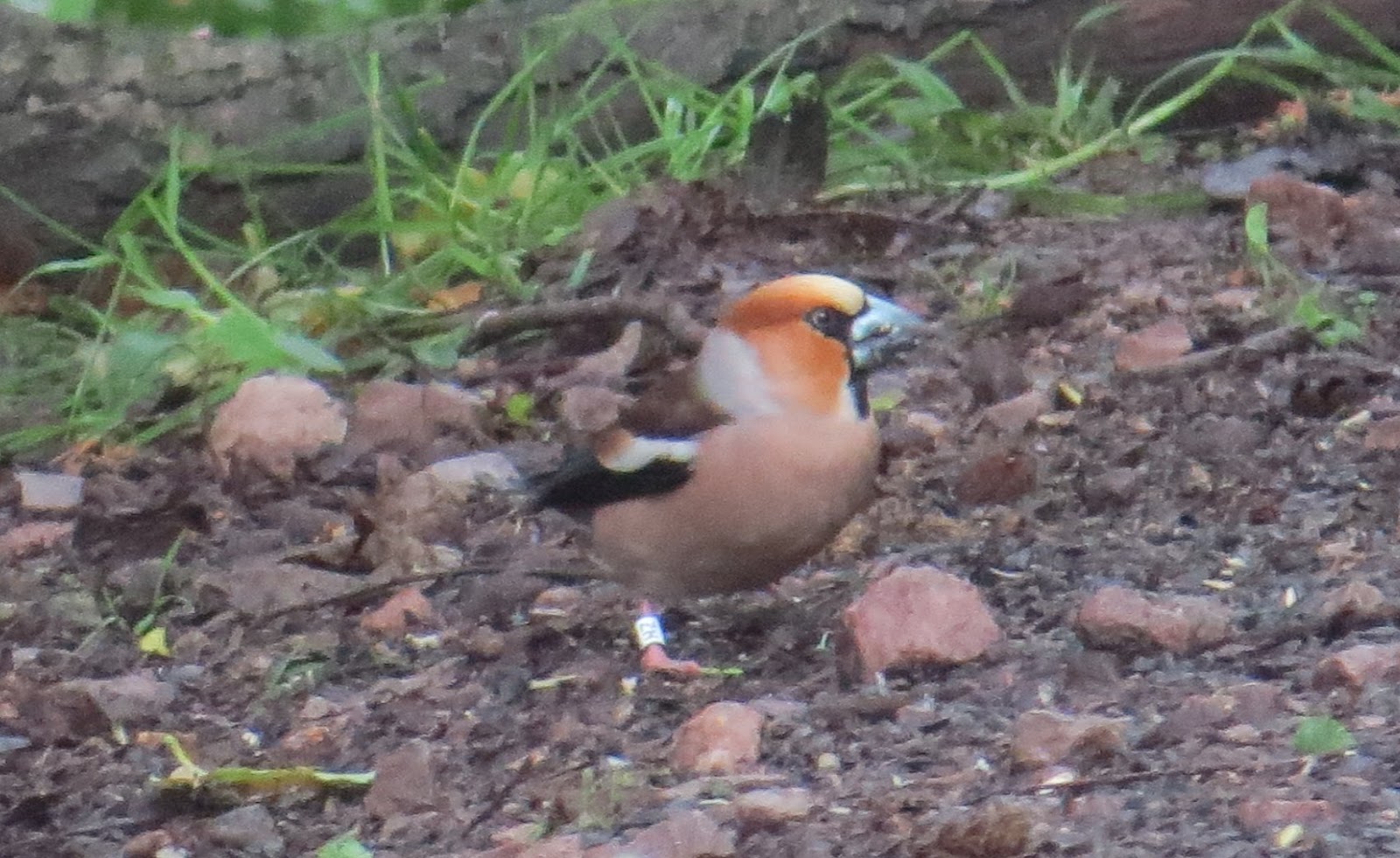
Photo by Vaughan Thomas  Hawfinch NW31779, ringed 1 May 2008 and re-caught 5 May 2018 (10 years, 4 days later)

Five of his recaptures had originally been ringed in 2010, making them comparable with his current British & Irish longevity record of 8 years 1 month 22 days. One female, caught on 5 May 2018, topped these however, having been ringed on 1 May 2008, 10 years and 4 days earlier; a big increase in longevity. This bird was ringed in the northeast of the Forest of Dean - nr Cinderford, was caught twice in April 2010 - near Tintern in the Wye Valley (20 km SSW), before now moving to near Chepstow (7 km further SSW).

What seems to be surprising is how rarely the 2010-ringed birds had been re-caught (three had been caught once since ringing, the other two hadn't been re-caught at all). Jerry's next challenge is to try and understand why these long-lived birds are not re-caught more often.

29 September 2017

Sligo's slippery slope to ringing

Mícheál Casey writes:

I started getting into ringing from reading the metal rings on gulls, particularly Common and Black-headed Gulls. Back in 2004, I read the ring of a handsome Common Gull, and was thrilled to hear back from Hugh Insley about where and when it was ringed. It was a chick (one of a brood of three) which was ringed on 26 May 1997 at Loch Tarff, near Fort Augustus, Highland, which was 400 km from where I saw it in Sligo Harbour, Ireland.

Common Gull. Photo by Mícheál Casey

I have seen this bird at least once every winter since 2004 and have just seen it back for its 20th year this weekend, looking quite fresh for its age.

Portfolio of this Common Gull. Photo by Mícheál Casey

I emailed Hugh when I decided to move on from ring-reading to training as a BTO ringer and I remember the reply well. He said it will add a lot to my birding, but it will also take away some of my enjoyment of birding, as my enjoyment of every bird or group of birds seen will be diluted by....."now how could I catch that?". He was partly right, but I have gained so much more than I have lost overall.

Common Gull. Photo by Mícheál Casey

This bird has a little way to go yet to break the longevity record of 27 years but hopefully it will keep returning to Sligo Harbour for a few more years to come; Mícheál will be waiting!

If you are able to read the ring of a gull while it's stealing your chips or just loafing around on the beach, please report it to www.ring.ac. You will be sent all the details on the bird and your record will help build a more complete picture of its movements.

13 September 2017

Record breakers of the bird world

Bird ringing has come a long way since it's inception in 1909. It was primarily set up to answer some basic questions, like where do our birds go and how long do they live. Since then, an amazing amount of information has been gathered that answers many more complex questions, like why a certain species population changes each year and where in Britain or Ireland are they declining. More information can be found on the BirdTrends and ringing surveys pages.

https://www.bto.org/volunteer-surveys/ringing/surveys/ras

 https://www.bto.org/volunteer-surveys/ringing/surveys/ces

At this time of year, all of the previous year's data have been loaded and checked and the Ringing and Nest Recording Team pull together some of this information to produce the Online Ringing & Nest Recording Report. The report includes annual totals for ringing and nest recording, as well as information on recoveries, but it also covers one basic question... how long can a bird live?

The longevity records for 2016 have now been updated and there are some interesting new records. Relatively new colonists like the Little Egret often feature. As they have only been ringed in any numbers in Britain and Ireland in the last fifteen years, we probably haven't yet established the normal maximum life expectancy; the record currently stands at 10 years and five months.

Little Egret chicks. Photo by Graham Giddens
Last year saw 17 records broken including three owl species; Barn Owl, Little Owl and Tawny Owl with ages reaching 15 years, 13 years and 23 years respectively. Some finches also did well with Twite, Lesser Redpoll reaching six years and Goldfinch reaching 10 years.

Lots of these record breakers were caught by a ringer, as opposed to being found dead or being identified by colour marks. Where ringers monitor the same populations annually, the potential for individuals to be caught again increases. This is exactly what happened with three of the record breakers, Little Ringed Plover, Peregrine and Nuthatch, which broke their own records after being re-encountered in 2016! 

The Puffin longevity record was broken again in 2016, and the oldest-known bird in Britain or Ireland is now a ripe old age of 37 years. The individual that broke the record, seen in the photo below, was ringed and re-encountered by the Shiants Auk Ringing Group, who ring in the Western Isles. The previous record holder was also a bird from the Shiants.

The oldest-known BTO-ringed Puffin, by Liz Scott.

We won't be analysing the 2017 records until next year but we already know that the current longevity record for Jackdaw has been broken. Originally ringed in April 1999 by Declan Manley, and subsequently re-caught in 2005, 2007, 2012 and now in 2017. A Goldfinch ringed in Nottinghamshire and found dead in Devon has also broken the 2016 longevity, adding another couple of months on to the current record.

Longevity records are the maximum a species has been recorded to live but most birds do not manage to reach this age. The average life expectancy and lots of other interesting facts can be found on our BirdFacts page.

07 July 2017

Who gives a hoot

Occurring throughout England, Scotland and Wales the Tawny Owl is well known, especially during the winter when their territorial calls can be heard during the night.

The Tawny Owl is amber listed, i.e. a species of medium conservation concern due to recent population declines. Surveying this species can be difficult, but studying them is easier due to their readiness to use nestboxes. Ringing the adults and their chicks, as well as following the progression of the nesting attempt (nest record), provides very useful information to help interpret population changes.
 

Adult Tawny Owl. Photo by Rachael Barber


Adult Tawny Owl with a more grey plumage. Photo by Lee Barber

The number of Tawny Owls ringed each year varies considerably; in the last five years the number ringed has ranged from 920 to 2,748 birds. The number ringed also varies by county, with ringers in Northumberland topping the list with an average of 183 birds per year. This is followed by Lincolnshire (107), North Yorkshire (100), Nottinghamshire (92), Norfolk (81) and Cumbria (81). Around 80% of the birds ringed each year are chicks. Ringing chicks enables researchers to follow an individual throughout its lifetime, providing vital information on where birds move to and exactly how long they live.

Tawny Owl chicks. Photo by Lee Barber

For most of the recoveries the BTO receive, the cause of death is unknown, but for some the cause of death is clear. Being hit by a vehicle is the most reported cause of death for Tawny Owls, followed by train casualty and drowning in artificial water containers like horse or cattle troughs. This doesn’t mean that 66% of all Tawny Owls die from vehicle strikes, however. Birds killed by vehicles are inevitably more visible than a bird that dies of natural causes in the middle of a wood. Also, as most of the birds that are reported are from areas with high concentrations of people, these are more likely to be reported when found.


By recapturing ringed birds, licenced bird ringers are in the privileged position to be able to gather information on the presence and condition of Tawny Owls that are alive and well. Last year one of our ringers re-caught a Tawny Owl that was originally ringed as long ago as 2003. This bird was ringed as a chick and re-caught in the same place (Kielder Forest, Northumberland), so the exact age of this bird is known (13 years). A bird ringed in 2004 at Rowlands Gill in Tyne and Wear which was also caught during 2016, that was an adult (at least 1 year old) so she could have been much older. It would have been doing very well to break the longevity record of 21 years 10 months.

Unlike some other owl species, Tawny Owls doesn’t generally travel very far or cross large bodies of water, so their distribution is restricted to mainland Britain.  Due to this behaviour we have had no foreign recoveries in the history of the BTO Ringing Scheme.

Tawny Owl chick about to be ringed. Photo by Lee Barber

I have received one recovery while working at the BTO, of a ring found in Iceland (without a bird) which was originally put on a Tawny Owl chick. This was an amazing record so (as with all our recoveries) some investigation followed. Unfortunately, this wasn’t quite as amazing as we’d hoped as we had a previous record that this bird had already died. The ‘used’ ring was put on a binocular strap for safe keeping after reporting. Some years later the finder was on holiday in Iceland when the strap broke and the ring was lost, only to be found later by someone else who reported it to the BTO via www.ring.ac.

The vast majority of data from ringing and the resulting finding of dead birds can provide an amazing amount of information, so if you do find a ringed bird please report it via www.ring.ac.  As a thank you, you will receive the information on where and when the bird was ringed.

27 May 2016

Elderly Shag strengthens our position in Europe!

Jim Lennon from the Shiants Auk Ringing Group writes:

Ringing seabirds can be mucky and challenging work, especially when you’re ducking under a rock to reach a Shag chick, while keeping an eye out for its protective parents (often the croaking male). However, this is soon forgotten when you receive news of one of them nearly 31 years later!


Shag chick 1227282 was one of a brood of three ringed on the Shiants Isles, Western Isles, on 30 June 1985 by Ms Sam Powell, a trainee ringer from South Wales working with the Shiants Auk Ringing Group. A total of 725 pulli from 377 broods was ringed on the Shiants that year.  Most of the subsequent recoveries were of birds that perished within the first 12 months, a few survived for four or five years and an exceptional bird was found dead after nine years.

But 1227282 outlived them all by a country mile.  For the next 30 years following ringing, it most likely spent its life breeding on the Shiants and in the waters of West Scotland, but we’ll never know for sure as it was never heard of again until John Taynton, a RSPB worker on the Shiants, found it freshly dead on 26 April 2016 i.e. a life span of 30 years 302 days.


According to the BTO’s latest longevity list (2014), this makes the Shiants bird the oldest ringed Shag in Britain & Ireland, and also in Europe (see Euring), raising the record by nearly a year.

Note:
The Euring information is not updated as regularly as the BTOs longevity lists because it needs to access all the data from all the Euring ringing schemes and this can take some time.  It currently indicates that a 34 yr old bird from the Shiants is Europe's oldest  Puffin but two just shy of 36 years old and one almost 37 years old, are listed on the BTO longevity records site.

13 July 2015

Another Hawfinch season over

With the short Hawfinch season over, it was time for Jerry Lewis to reflect on how it had gone this year.

After his best ever season last year, 2015 had been a "bit slow" with just 94 birds ringed, and 34 recaptured from previous years (but good quality data for the RAS). One bird however was particularly noteworthy and was Jerry's second record of an eight year old bird. The previous bird (see here) could not be individually identified so its age could have ranged from a couple of weeks under eight years, to a few days over. On 2nd June, RSPB researcher, Rob Hughes, was watching one of the feeding sites, and saw a male with a white colour ring (which was unusual as orange rings had been used for the previous two years).

Mystery Hawfinch by Rob Hughes

While doing some routine mist netting with Will Kirby and Andy Stanbury, they caught the bird on 3rd June, and Jerry caught him again on 18th. It turned out to be NW31557, first ringed on 27 April 2007 at the same feeding site. In the intervening years, he had been caught three times in April 2009 (at the same site), and once more on 26 May 2013 (at a feeding site some 15 km to the south). His original single colour ring was missing on this last recapture, and he was fitted with a new inscribed colour ring - white inscribed with ZH. There is no way of knowing where he has spent most of the intervening years, but he had obviously not been regularly visiting any of the feeding sites. The latest capture is probably (see below) a new UK longevity record at 8 years, 1 month, 22 days.

Hawfinch by Rob Hughes

11 May 2015

Exemplary patch working

Local birder Lee Collins writes:

Dawlish Warren is a 1½ mile long sand spit at the mouth of the River Exe in south Devon and is an important roost site for thousands of wintering and passage waterbirds of the Exe Estuary SPA. It has an impressive list of rare vagrants that include- Long-billed Murrelet, Elegant Tern, Short-toed Eagle and Semi-palmated Plover.

However, the patch-workers on site aren't confined to purely finding rare birds; with the benefit of a well positioned hide a dedicated band of regular recorders at Dawlish Warren submit to the BTO and county recorders in excess of 7,000 counts per annum and have developed a growing interest in finding and recording ringed birds in the field. 

With no current ringing on site, all recoveries from recent years have been achieved only by using our optics and a keen eye. In 2014 alone the recording group amassed an incredible 398 reads of 192 individuals, something few sites in the whole of the UK can match.

Recent observations have yielded some important and interesting recoveries with birds ringed from 24 different countries, including Ghana, Mauritania, Greenland, Iceland and Russia, whilst others have had a well-travelled history taking in Namibia and South Africa. 

Common Tern, Dawlish Warren, 29th Aug 2014, darvic ringed at Saltholme, Lee Collins

Notable finds include the first Devon recovery of Little Tern (from Dublin) and the first live Roseate Tern (from Coquet Island, off Northumberland). Common Tern (Saltholme in Teeside & Dublin) and Grey Plover (from Spain & Norway), although common species, hadn't had a Devon recovery in 25 and 50 years respectively. Both the Grey Plovers are notable as being the first Spanish & Norwegian controls of this species in Britain or Ireland, a feat the Recording Group also achieved for a Spanish Spoonbill.

Colour-ringed ‘Sanderblings’ as they've now become known are also a definite highlight and we've recorded 18 in just a few short years. Most have been from ringing schemes from their breeding grounds in Greenland and wintering grounds in West Africa (Ghana & Mauritania), with one of our recoveries also observed in Namibia. This species certainly has a breath-taking migratory pattern.

Sanderling, Dawlish Warren, 20th Jul 2009, Ghanian ringed, Lee Collins

The results of reading rings in the field has also established useful site fidelity and longevity data, in wintering species such as Brent Geese, Shelduck and more specifically Oystercatchers, with five of our Oystercatcher reads being individuals 24 years old or older. One faithful Great Black-backed Gull, from south Cornwall, has to date been read 49 times over a 31 month period on site and another Great Black-backed Gull was seven months from beating the oldest one on record (our Great Black-backed Gull was ringed on the Channel Islands in 1990. Another great gull sighting was the first Lituanian ringed Herring Gull in the UK as well (below).

Herring Gull (Argentatus), Dawlish Warren, 31st Dec 2014, Lithuanian ringed, Lee Collins

Since May 2004, the Dawlish Warren website has been updated daily with latest bird and wildlife news and regularly carries news on the latest recoveries. Annual reports (2013 & 2014) on Warren ring recoveries are available for 2013 and 2014 in pdf format.

Ringed Plover, Dawlish Warren, 4th Oct 2014, Norwegian ringed, Lee Collins

It’s very much hoped that our hard work and dedication in finding and documenting such records can rub off on others, as such endeavours serve a useful cause and can be extremely rewarding.

We’d also like to thank the BTO and various ringers for their invaluable help over the last few years.

21 April 2015

Elusive Hawfinch 'shows a bit of leg'

Chris McGuigan writes:

I recently received an email from Barry Farquharson, a local birdwatcher who has become rather good at reading - and photographing - colour-ringed birds (usually gulls).

This one was different though, it read: "Going through some fairly poor photos from Scone Palace, Perth, I've managed to find a ringed Hawfinch in one, although unfortunately only one leg is visible. I assume it will be a local bird, but just in case.... Looks like red over orange on the right leg."

In actual fact, in the photograph (see below) you could just see the other leg too which looked like 'black over metal'.

Colour ringed Hawfinch. Photo by Barry Farquharson

Armed with this information and suspecting it had been ringed locally (but some time ago) I contacted Neil Morrison as well as the BTO 'Hawfinch colour-ring data coordinators'. Neil confirmed that he hadn't ringed any in recent years but that his records were all in storage. Eventually he was able to confirm that this female bird had been ringed at Scone Palace on 17th February 2007, as a probable first-year bird. Thus 2 days short of 8 years had elapsed from capture to re-sighting, becoming one of the oldest Hawfinch recorded in the BTO Ringing Scheme.

Well done to Barry who I'm sure will be pointing his camera at birds' legs even more in future!

Ed. note - the Online Ringing Report (ORR) shows that only 58 Hawfinches were ringed in 2007 so this is a great record. The ORR, including the longevity records, will be updated in July to include 2014's data. It remains to be seen whether this bird will become the longevity record holder at that point!

30 March 2015

Leicestershire produces record Nuthatches

Ian Gamble writes:

"Birds have been ringed in my parent’s garden in Quorn, Leicestershire, for some 60 years and this has provided us with a wealth of information on our local birds. The garden, which is 80 feet long and 40 feet wide, borders onto a mixed woodland called Kay’s Plantation. In 1991 I married and left Quorn for Hertfordshire and now only return to Quorn to visit family, usually over New Year on my father's birthday (20th March). During these periods I get a few hours ringing in while they are still sleeping.

Ian's parents' garden in Quorn
Nuthatch is a localised resident in Quorn and regularly feeds in the garden and had nested on and off for nearly 50 years in a nest box that my father had put up at the bottom of the garden until it fell off few years ago. You would always know when the birds were starting to use the box because they would plaster mud around the entrance hole. These birds are sedentary and we catch the same individuals with some regularity over two or three years. The largest number caught in any one year was five in 1967, and we have ringed four birds in a year on four occasions, with 74 individuals ringed in the garden over the years.

Prior to this latest capture, the oldest individual retrapped was 4 years 6 months old. Over the last few years my father had kept saying to me he thought the male Nuthatch was quite old, but no matter how hard I tried I couldn't catch it. Sunday 22nd March 2015 (whilst visiting my father on his 88th birthday) was a fine still morning and I decided to get in a few hours ringing in before church. One of the birds caught was a Nuthatch; an adult male with ring number TE27966. I immediately realised it was old, but not quite sure just how old!

Nuthatch in the garden (not the record-breaker, who was camera-shy)
On my return home to Hertfordshire I checked it out on IPMR and found that I had ringed it on 31st December 2005, making it well over nine years old! I had previously retrapped this bird on 24th March 2007, 21st March 2009 and 1st January 2010. As highlighted above, this is one case where understanding the movements of the ringer is more important than the movements of the bird..."

The previous longevity record for Nuthatch was a bird ringed in the nest May 1964 (also in Leicestershire!) and killed by a cat  in February 1973, making it 8 years 8 months old.

12 September 2013

Ringing Report for 2012 goes live

The British and Irish Ringing Scheme is one of the oldest in the world and has collected a wealth of information on the movement, survival and population change of bird species in Britain and Ireland.
 
Green Woodpecker by John Flowerday

The Online Ringing Report has just been updated. This includes the number of birds ringed and recaptured in 2012 and also the recovery and re-sighting information by county or species. For example the BTO Atlas species for the month is Green Woodpecker and the online report shows that we ringed 333 birds in 2012 compared with 406 in 2011 and 414 in 2010, so quite a drop in numbers over the past couple of years. We can also see a summary of all ringing recoveries for this species, which includes information on some of the oldest recorded birds found, and what happened to them. The longevity record for this species is 15 years set in 1985 when a bird was hit by a vehicle near Chertsey, Surrey.
 
Foreign location of birds ringed or recovered in Britain & Ireland since 1909 

If you are interested in a particular species or just certain locations or dates, the information is accessible via the Online Ringing Reports.

05 December 2012

Kent Common Gull sets new longevity record

Derick Hiemstra and his 69-year-old father (below) are dedicated gull ringers in The Netherlands, ringing from their garage at Surhuisterveen. When they caught Common Gull EK42603 on 1st December, they noticed that the ring was rather worn, and as this was the first British-ringed Common Gull they'd caught, they were interested to know how old it was.


It turns out that EK42603 was ringed as a first-winter bird at Sandwich Bay (Kent) on 12th January 1985, making it almost 28 years old. This is a new longevity record for a UK Common Gull, beating the previous record of 25 years of an Irish bird.


Quite incredibly, Derick also held the European longevity record, resighting a Danish bird (5003247) almost 34 years after ringing!

But EK42603 now also has a shiny new colour ring (white E61K), so hopefully this isn't the last we'll hear of this OAG.

Check out more UK longevity records online here, and European records here.

02 November 2012

Great Spotted Woodpecker reaches a Great age

Since 1909, ringing has occurred on these islands and with all this information, a great deal has been learnt about how long wild birds live.

The BTO has compiled a longevity list that is updated annually here, which includes the details of the oldest British and Irish birds wearing a BTO ring. At 3 years 2 months, the Firecrest burns out quite quickly, to the other end of the spectrum of the 50-year old Manx Shearwater.

Longevity records are beaten relatively rarely so it's a special occasion when a ringer re-catches a record breaking bird, unless it's a recently colonised bird like a Little Egret (9 years 6 months) or Egyptian Goose (12 years 5 months).

Female Great Spotted Woodpecker

The last longevity record for a Great Spotted Woodpecker was set in 1976 with a bird caught in Rochester, Kent. That has now changed with Alan Ball contacting us about a 10 year, 10 month and 30 day, female woodpecker at Bourne Wood, Lincolnshire!


The wing of a definite adult Great Spotted Woodpecker with retained primary covert

This year has also produced several old Blue Tits in Bourne Wood including one 7 years 11 months and one 7 years 10 months and another aged 7 years. Just a couple more years to break these records as well.

Thanks to Alan for letting us know and for the photographs. The online longevity pages will show his record once we have all the data in for this year.

25 October 2010

A long life for an Oystercatcher

Adding to the recent run of longevity records being broken, an Oystercatcher is being put in the hall of fame after it had been caught by the Wash Wader Ringing Group this summer.

The previous longevity record for an Oystercatcher was 36 years, 8 months and 16 days, which was put on Oystercatcher SS88071 back in 1969 and was then found dead in Norway in 2006.

The new record belongs to Oystercatcher SS58540 which was ringed by Adrian Blackburn at Friskney Marsh (TF4650) as a chick on 14 June 1970 and we now know it's still going strong. As this bird has lived unusually long, its ring has had to be replaced a couple of times to keep it in tip top shape. Because of this, Oystercatcher SS58540 is also known as FC15938 and FP99170. Amazingly after all this time it hasn't been caught or seen away from the site where it was first ringed.

The record now stands at 40 years, 1 month and 2 days!

Thanks to John Harding for the photo and all the ringers involved.

14 October 2010

Longevity gets even longer

Dave Okill writes:

"During the summer three ringed birds have turned up in Shetland that have beaten the age records in the BTO files for the longest living individual of that species.

The first was a Storm Petrel. Originally ringed on Fair Isle on 29 July 1974, it was then recaught on Mousa 26 May 2010, making it just short of 36 years between ringing and being found again. As Storm Petrels don't usually come back to the North Atlantic until they are 2 years old, then it's likely this bird was at least 38 years old. The previous oldest recorded Stormie was 31 years and 11 months old so this record has increased the longevity considerably.

The next was a Whimbrel on Fetlar that was posted previously here.


The third was a Red-throated Diver. A bird that I'd ringed as a chick on Unst in 1986 was found breeding a couple of kilometres from the site where it fledged, now 24 years old. Male Red-throated Divers starting to breed usually return to a site close to where they were hatched but females disperse more widely.

As all of these birds are still going, it could be that if we hear of them again they will extend the records further."

Thanks to Dave Okill for letting us know and to Malcolm Smith for the photo.

21 September 2010

Another longevity record, this time its a Tern

The Farne Islands in Northumberland is famous for its sea bird population and ringing has been done by the National Trust, in partnership with the Natural History Society of Northumbria Ringing Group giving a great insight into their birds movements and life spans.

One of these birds, Arctic Tern CE60645, was ringed on 28th June 1980 and has been recaptured this year, making it the oldest Arctic Tern in the UK!


The arctic tern was recently discovered to have the longest migration route of any animal, flying an estimated 44,000 miles return trip, between their breeding grounds in Greenland to Antarctica in an ‘S’ shape to take advantage of prevailing global wind systems in order to preserve energy.

Click here to go to the BBC news website for more information.

Thanks to Jill Pakenham for the photo.

15 September 2010

New Whimbrel longevity record

Allan Perkins writes:
This summer I spent 3 months on Fetlar, Shetland, studying the breeding success of Whimbrel to help investigate their 'recent' declines. Previous studies by Murray Grant on Fetlar and Unst in the 1980s had involved catching and colour-ringing adult Whimbrel, to monitor brood survival and returning rates of adults from their tropical wintering grounds in subsequent breeding seasons. During 1986-88, 97 Whimbrel were colour-ringed and of those the returning rates were high - c. 89% seen the year after ringing - and most birds returned to breed at the same site used in the previous year. Sightings of some of these birds on Fetlar continued up until the mid-1990s, but none had been recorded since then.


It was on 9 May, this year when I first saw one of these colour ringed birds feeding on the short cliff-top turf of Strandburgh Ness, at the extreme northeast tip of Fetlar. Frustratingly it wasn't until 31 May that I managed to get good views of the colour ring combination and amazingly it was a bird ringed in the 1980s.


The bird was identified as EK92102, ringed as an adult breeding on Fetlar on 1 June 1986, and sexed as a male from subsequent observations. Given that Whimbrels do not normally start to breed until they are two or three years old, this bird must be at least 26 years old, making it the oldest known Whimbrel in the world! This surpasses the previous longevity record of 16 years, held by a Whimbrel ringed as a chick on Mainland Shetland in June 1979 and shot in northern France in August 1995.

EK92102 was last recorded in 1995, but it seems likely that it had been returning, undetected, to Fetlar each year since then. Maybe it will return again next year for potentially its 26th breeding season.

Thanks to Allan for letting us know about this bird and also to Murray Grant for the lower photo.

01 March 2010

Red-necked Phal breaks longevity record

OK, so it's actually just an excuse to put up these stunning images sent in today by Iain Leach!


NT14343 was ringed as a nestling on Fetlar (Shetland) in July 1996, and photographed by Iain on the island in June 2008 and June 2009. So when last seen it was a month short of being 13 years old, which is a fantastic age for a bird that spends a great deal of its time at sea.


This is also a European longevity record, beating an Icelandic bird aged 9 years. Amazingly, the previous BTO longevity record was held by NT14346, a bird of the same brood of four as this one, last seen on Fetlar in 2003.

Thanks again to Iain for the photos and for the excellent reports.

04 September 2009

World's oldest Whitethroat!

When ringers at Stanford Reservoir, Northants, caught Whitethroat ring number P774799 on 2 August 2009 they didn't think much of it. It was only later they realised that it had been originally ringed at the same site on 3 August 2002. Since then it was a regular at the site, though did go missing in 2007.

Seven years old might not seem like much, but P774799 is now the oldest recorded Whitethroat in Europe (and presumably the world?), beating a six year old Lincolnshire bird found dead back in 1992.

What is more amazing is that just in migrations alone, it will have made the 7,000 mile return trip to/from Africa seven times, crossing the Sahara 14 times!

Thanks to Adam Homer at Stanford Ringing Group for letting us know about this amazing bird.

17 July 2009

Shiants OAP

Old Age Puffin that is...

The Shiant Auk Ringing Group has just got back from a record-breaking expedition. The group broke the British longevity record when they caught a 32 year old Puffin (EX08155) on 5 July, originally ringed on the island in June 1977. Incredibly EX08155 was originally ringed by Ian Buxton (below), who was also a member of this year’s team: bird and man reunited 32 years later!


But the group beat their own record just five days later, when Ian recaught EB73152, originally ringed in June 1975. This makes it over 34 years old: older than three of this year’s expedition members! This is now also the oldest Puffin in Europe, beating an Icelandic bird of 33 years old.

Amazingly, it not only still had its original metal ring (below, looking good after 34 years), but also its colour ring, allowing it to be identified as a Shiants bird ‘in the field’.