Showing posts with label puffin. Show all posts

13 September 2017

Record breakers of the bird world

Bird ringing has come a long way since it's inception in 1909. It was primarily set up to answer some basic questions, like where do our birds go and how long do they live. Since then, an amazing amount of information has been gathered that answers many more complex questions, like why a certain species population changes each year and where in Britain or Ireland are they declining. More information can be found on the BirdTrends and ringing surveys pages.

https://www.bto.org/volunteer-surveys/ringing/surveys/ras

 https://www.bto.org/volunteer-surveys/ringing/surveys/ces

At this time of year, all of the previous year's data have been loaded and checked and the Ringing and Nest Recording Team pull together some of this information to produce the Online Ringing & Nest Recording Report. The report includes annual totals for ringing and nest recording, as well as information on recoveries, but it also covers one basic question... how long can a bird live?

The longevity records for 2016 have now been updated and there are some interesting new records. Relatively new colonists like the Little Egret often feature. As they have only been ringed in any numbers in Britain and Ireland in the last fifteen years, we probably haven't yet established the normal maximum life expectancy; the record currently stands at 10 years and five months.

Little Egret chicks. Photo by Graham Giddens
Last year saw 17 records broken including three owl species; Barn Owl, Little Owl and Tawny Owl with ages reaching 15 years, 13 years and 23 years respectively. Some finches also did well with Twite, Lesser Redpoll reaching six years and Goldfinch reaching 10 years.

Lots of these record breakers were caught by a ringer, as opposed to being found dead or being identified by colour marks. Where ringers monitor the same populations annually, the potential for individuals to be caught again increases. This is exactly what happened with three of the record breakers, Little Ringed Plover, Peregrine and Nuthatch, which broke their own records after being re-encountered in 2016! 

The Puffin longevity record was broken again in 2016, and the oldest-known bird in Britain or Ireland is now a ripe old age of 37 years. The individual that broke the record, seen in the photo below, was ringed and re-encountered by the Shiants Auk Ringing Group, who ring in the Western Isles. The previous record holder was also a bird from the Shiants.

The oldest-known BTO-ringed Puffin, by Liz Scott.

We won't be analysing the 2017 records until next year but we already know that the current longevity record for Jackdaw has been broken. Originally ringed in April 1999 by Declan Manley, and subsequently re-caught in 2005, 2007, 2012 and now in 2017. A Goldfinch ringed in Nottinghamshire and found dead in Devon has also broken the 2016 longevity, adding another couple of months on to the current record.

Longevity records are the maximum a species has been recorded to live but most birds do not manage to reach this age. The average life expectancy and lots of other interesting facts can be found on our BirdFacts page.

06 March 2014

The wreck continues...

The storms battering western Europe may have abated somewhat, but the number of birds washing up on beaches across Spain, France, Ireland and Britain have not. There is usually a delay in the number of birds washing up after such events, but we are still hearing about large numbers of auks, Puffins and Shags on beaches.

We previously posted about the number of Puffins being found in France, but in he last week birds have been turning up along the west coast of Ireland and Britain. Statements such as "I found this ringed bird among 148 dead puffins on 900 meters of beach" are sadly common place.

Winter-plumaged Puffin
Gunwalloe Fishing Cove, Cornwall (Mark Grantham)
The number of ringed birds reported now stands at:
  • 124 Puffin
  • 104 Guillemot
  • 98 Razorbill
  • 75 Shag
  • 7 Gannet
  • 4 Black Guillemot
For the time of year, these are record numbers of both Guillemot and Puffin. Looking back at January/February recoveries of these birds, we can see just how unprecedented this current event is.

Number of Jan/Feb ring recoveries of Puffin
Number of Jan/Feb ring recoveries of Razorbill
Number of Jan/Feb ring recoveries of Guillemot

This will be a small fraction of the total amount of birds that have died (now well over 28,000 birds) but these ringed birds do tell us something about the birds affected. Many of the Puffins are from sites including Sule Skerry (40km west of Orkney), the Shiant Islands (Outer Hebridies), the Treshnish Islands (near the Isle of Mull), Great Saltee (off Co Wexford) and Skomer Island (Pembrokeshire).

Razorbill M91165 was ringed as a chick on Sanda Island in 1997.
It was one of 40 birds found at Watergate Bay, Cornwall,
on Valentine’s Day. © Newquay Beach Care

19 February 2014

Puffin wreck in France

In recent weeks the full impact of the winter's storms on some of our seabirds has become apparent. With many birds now returning to breeding ledges in western Europe, they will have been caught up in the incessant low-pressure systems hitting our coasts making feeding, and life in general, very difficult. Here in the office we've received many reports of storm-driven auks and Shags, but standing out were reports of dead Puffins in France.

Razorbill M91165 was ringed as a chick on Sanda Island in 1997 and was one of 40 birds found washed ashore at Watergate Bay, Cornwall on Valentine's Day. Photo: Newquay Beach Care.
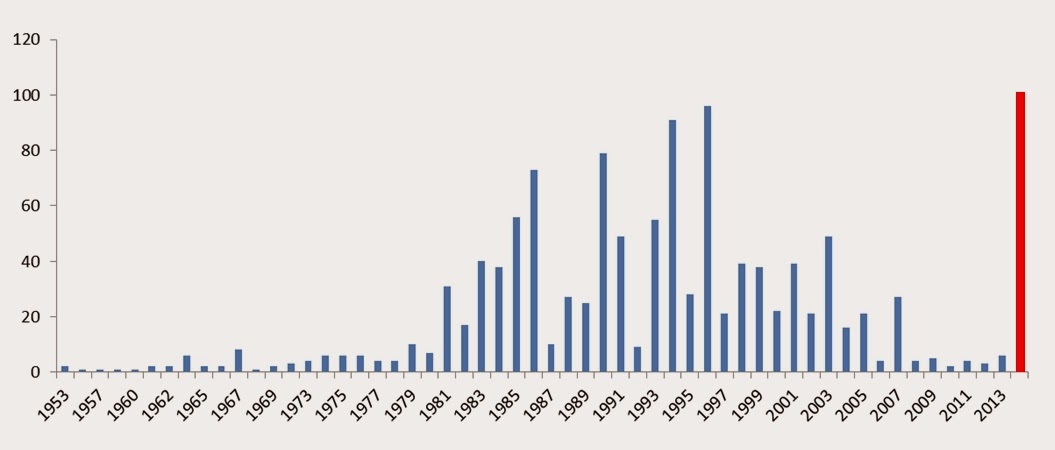
Looking back at the number of winter Puffin recoveries we normally receive from abroad (below), the total varies from year to year, but averages at fewer than three. We've seen smaller wrecks before, including 16 birds in both 1979 and 2003, but so far this year we've received reports of an unprecedented 38 birds. It's sobering to think these are just the ringed birds we know about, and each report of a ringed bird comes with the comment "one ringed bird amongst many more on beach".

Annual number of winter Puffin recoveries from abroad
You might think that the change in the number of recoveries might be due to a change in the number of birds ringed, but for such a long-lived species any changes in the annual ringing total will have minimal impact on the proportion of the population that's ringed. In fact, there were more birds ringed in the 1980s that any time since. Check the annual ringing total for Puffin on the Online Ringing Report.

Whilst seabird populations can be remarkably resilient in response to such events, it'll be interesting to see just what impact these storms have on our breeding seabirds.

22 April 2013

Tough times for sea birds

As you heard in a previous post, we have been receiving large numbers of reports of dead or dying Barn Owls. What we didn't mention is that we are also receiving reports of large numbers of dead seabirds on the east coast of Scotland and northern England but also as far south as East Anglia.

The majority of these birds have been found in the Firth of Forth, Scotland, and this seabird wreck has occurred at a time when these birds should be getting into prime condition for the breeding season, or even nesting now. High winds and 'uncomfortable' sea conditions are thought to be the prime cause, making finding food difficult.

Colour ringed Shag - Sarah Featherstone

The majority of reports of ringed birds have been Shag but have also included a wide variety of species, including Puffin, Razorbill, Guillemot, Kittiwake, Cormorant and even Little Auk. The graphs below show the 10 year average of reports (blue) against the number of reports so far this year.


You can clearly see the huge difference between early and late March. The number in early April is slightly less than late March and early indications show that late April will have many fewer reports of dead shags, as long as the trend continues.


 We receive very few recoveries of dead Puffins generally during the winter period but this year in late March we can see evidence of the wreck.


Strangely, Guillemots have fared very well, considering the previous two species, with a lower than average report rate. Although there have been large numbers of Guillemots washed up in Cornwall and Devon from a synthetic chemical called polyisobutene. Surprisingly only nine dead and two live Guillemots (which are yet to show in the graph above) have been found ringed out of a minimum estimate of 1500 dead birds.

14 March 2011

Mystery Puffin Deaths in Spain

During the last couple of weeks, the north coast of Spain has been dotted with dead Puffins. Up until last weekend a total of 72 birds had been found.
The puffin is a pelagic species of auk which spends its winter in the middle of the Atlantic and North Sea, where it is vulnerable to oil spills and bioaccumulation of heavy metals.

Sadly this morning, we received a report of one of these dead Puffins, found on a beach near Gijón wearing a BTO ring! We discovered that it was ringed as an adult in July 2009 on the Shiant Islands in the Western Isles of Scotland.


We don't know where this bird spent the winter or where it exactly died because it would have been brought to the coast on the oceanic currents.


View Puffin EW81339 in a larger map

We hope to hear again from the finders if they discover the cause of death after the postmortem.

Thank you to Marco García for sharing the story and to José Antonio Larriba for the photographs.

17 July 2009

Shiants OAP

Old Age Puffin that is...

The Shiant Auk Ringing Group has just got back from a record-breaking expedition. The group broke the British longevity record when they caught a 32 year old Puffin (EX08155) on 5 July, originally ringed on the island in June 1977. Incredibly EX08155 was originally ringed by Ian Buxton (below), who was also a member of this year’s team: bird and man reunited 32 years later!


But the group beat their own record just five days later, when Ian recaught EB73152, originally ringed in June 1975. This makes it over 34 years old: older than three of this year’s expedition members! This is now also the oldest Puffin in Europe, beating an Icelandic bird of 33 years old.

Amazingly, it not only still had its original metal ring (below, looking good after 34 years), but also its colour ring, allowing it to be identified as a Shiants bird ‘in the field’.