Showing posts with label Hawfinch. Show all posts

08 June 2018

A big jump in Hawfinch Longevity

With the influx of Hawfinch into southern Britain this winter, Jerry Lewis started one of his feeding sites much earlier than usual (in mid January) hoping to try and catch some of the visitors. Despite a decent sized flock of 40+ birds visiting the feeding site, they were mainly coming down to Hornbeam seed, rather than sunflower seeds. After two months, catching had been very slow (just 16 birds caught, at a rate of one every three hours), but after mid March it started to pick up. The largest catches began from mid-April onwards (as happens most years), averaging a 'finger numbing' two birds per hour. 

Despite problems at two of the feeding sites - sunflower seeds being taken by squirrels/wild boar (leaving few for the birds) and a road closure preventing access to a third site, it was Jerry's most successful year to date. By the time his 'catching season' was over he had caught 202 birds, which included 43 that had been ringed in previous years (plus a small number of same-season recaptures). It is unlikely that many (any) would have been continental birds, as migrants had generally left by early April in previous years.

Photo by Vaughan Thomas  Hawfinch NW31779, ringed 1 May 2008 and re-caught 5 May 2018 (10 years, 4 days later)

Five of his recaptures had originally been ringed in 2010, making them comparable with his current British & Irish longevity record of 8 years 1 month 22 days. One female, caught on 5 May 2018, topped these however, having been ringed on 1 May 2008, 10 years and 4 days earlier; a big increase in longevity. This bird was ringed in the northeast of the Forest of Dean - nr Cinderford, was caught twice in April 2010 - near Tintern in the Wye Valley (20 km SSW), before now moving to near Chepstow (7 km further SSW).

What seems to be surprising is how rarely the 2010-ringed birds had been re-caught (three had been caught once since ringing, the other two hadn't been re-caught at all). Jerry's next challenge is to try and understand why these long-lived birds are not re-caught more often.

13 July 2015

Another Hawfinch season over

With the short Hawfinch season over, it was time for Jerry Lewis to reflect on how it had gone this year.

After his best ever season last year, 2015 had been a "bit slow" with just 94 birds ringed, and 34 recaptured from previous years (but good quality data for the RAS). One bird however was particularly noteworthy and was Jerry's second record of an eight year old bird. The previous bird (see here) could not be individually identified so its age could have ranged from a couple of weeks under eight years, to a few days over. On 2nd June, RSPB researcher, Rob Hughes, was watching one of the feeding sites, and saw a male with a white colour ring (which was unusual as orange rings had been used for the previous two years).

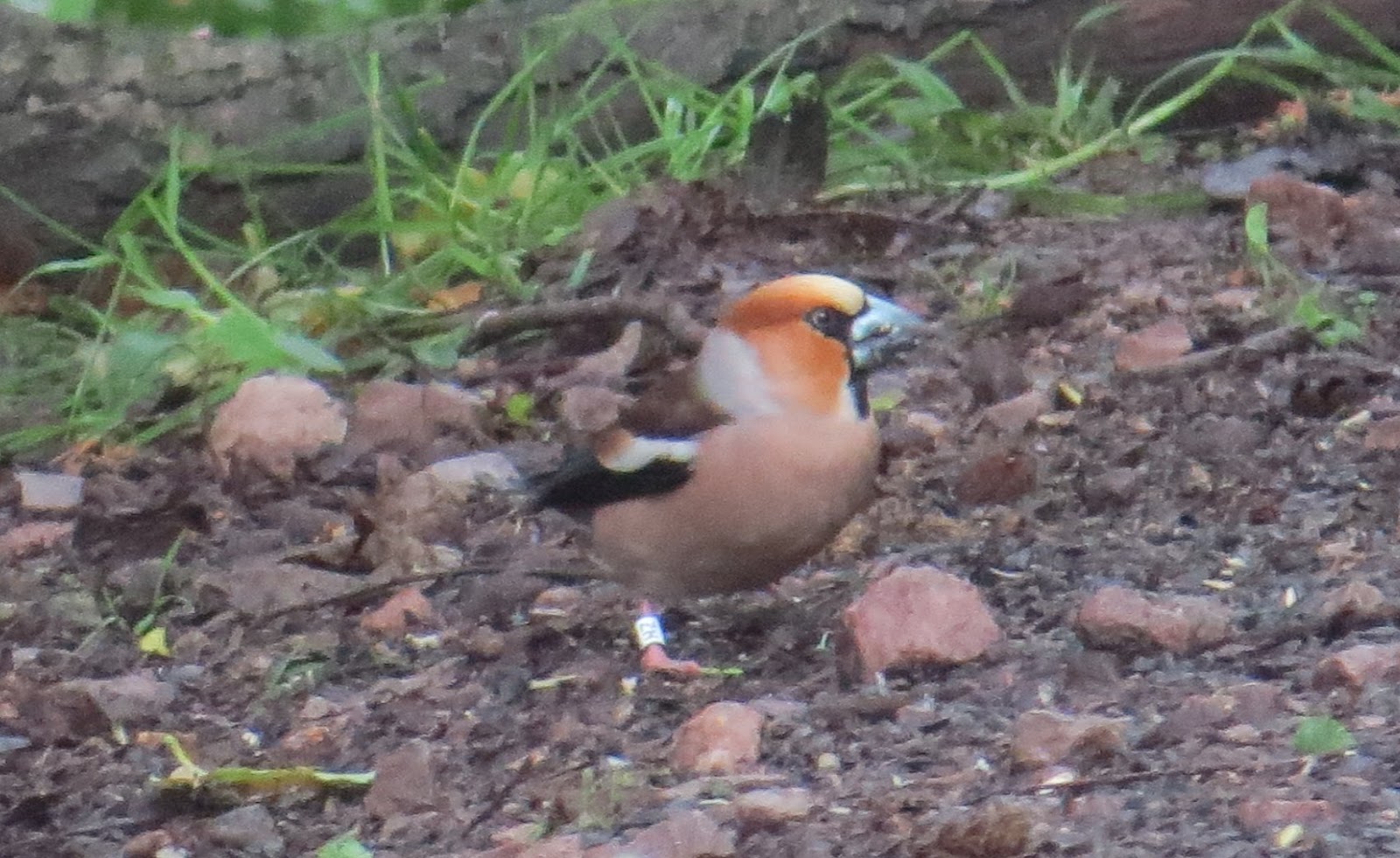
Mystery Hawfinch by Rob Hughes

While doing some routine mist netting with Will Kirby and Andy Stanbury, they caught the bird on 3rd June, and Jerry caught him again on 18th. It turned out to be NW31557, first ringed on 27 April 2007 at the same feeding site. In the intervening years, he had been caught three times in April 2009 (at the same site), and once more on 26 May 2013 (at a feeding site some 15 km to the south). His original single colour ring was missing on this last recapture, and he was fitted with a new inscribed colour ring - white inscribed with ZH. There is no way of knowing where he has spent most of the intervening years, but he had obviously not been regularly visiting any of the feeding sites. The latest capture is probably (see below) a new UK longevity record at 8 years, 1 month, 22 days.

Hawfinch by Rob Hughes

21 April 2015

Elusive Hawfinch 'shows a bit of leg'

Chris McGuigan writes:

I recently received an email from Barry Farquharson, a local birdwatcher who has become rather good at reading - and photographing - colour-ringed birds (usually gulls).

This one was different though, it read: "Going through some fairly poor photos from Scone Palace, Perth, I've managed to find a ringed Hawfinch in one, although unfortunately only one leg is visible. I assume it will be a local bird, but just in case.... Looks like red over orange on the right leg."

In actual fact, in the photograph (see below) you could just see the other leg too which looked like 'black over metal'.

Colour ringed Hawfinch. Photo by Barry Farquharson

Armed with this information and suspecting it had been ringed locally (but some time ago) I contacted Neil Morrison as well as the BTO 'Hawfinch colour-ring data coordinators'. Neil confirmed that he hadn't ringed any in recent years but that his records were all in storage. Eventually he was able to confirm that this female bird had been ringed at Scone Palace on 17th February 2007, as a probable first-year bird. Thus 2 days short of 8 years had elapsed from capture to re-sighting, becoming one of the oldest Hawfinch recorded in the BTO Ringing Scheme.

Well done to Barry who I'm sure will be pointing his camera at birds' legs even more in future!

Ed. note - the Online Ringing Report (ORR) shows that only 58 Hawfinches were ringed in 2007 so this is a great record. The ORR, including the longevity records, will be updated in July to include 2014's data. It remains to be seen whether this bird will become the longevity record holder at that point!

10 July 2014

Hawfinch longevity on the up

The longevity record for a British ringed Hawfinch has stood for many decades at 6 years, 9 months and 4 days: not surprising really as so few had been ringed, and even fewer recaught or found.

BTO ringer Jerry Lewis spends most of April each year catching (and more importantly recatching) and colour-ringing birds at feeding sites in the Forest of Dean. In 2012, he caught three birds that he had previously been ringed six years earlier, and began to think that a new longevity record was perhaps in sight. He didn't have to wait long, as soon after this he caught another two birds that had been ringed in 2005: NW21506 was the older of the two, at 6 years, 11 months and 24 days. Fast forward to 2013 and another two seven-year-olds were recorded, but photographed this time allowing their colour rings to be read. This gave an impressive selection of old birds, and a better indication of the actual age that Hawfinch can regularly reach.

However, in April this year, local birder Phil Mugridge photographed a bird with a red colour ring over a metal right on its left leg, a combination only used on 17 birds ringed in April 2006, so an even older bird at eight years.

LBR,M in April 2014
The next few years are likely to see further captures and sightings of birds originally ringed in 2005, 2006 or 2007, so no doubt the longevity record will continue to be pushed even higher.

Thanks to Jerry for letting us know about this excellent project and to Phill Mugridge for the excellent photo of this old age Hawfinch.

24 April 2014

Heaps of Hawfinch

In 2001, Jerry Lewis, had his first Hawfinch catch (7 birds) in the Forest of Dean. He was "well pleased" because, at the time, only 1368 Hawfinch had been ringed in the UK. His capture rate improved in the following years, and by 2007 he had ringed almost 100 birds. Understanding the birds' behaviour in the late winter/early spring, was key to his success (see Ringers' Bulletins Vol 12-1 Summer 2007 and Vol 12-6 Winter 2009).

In 2010 he was joined by two other ringers (Adrian Thomas and Rob Husbands) and seven feeding sites have been operated in the Dean/Wye Valley by the three of them since then. Around 200 birds were ringed in 2010 (see previous Demogblog post) and again in 2012 and 2013. Although catching has been relatively quiet this year, on 17 April, Jerry ringed the 1000th bird for the project - a fantastic achievement, with what is still a species rarely caught by the majority of British ringers.

This young female Hawfinch became the 1000th ringed Hawfinch for the Dean/Wye Valley project
They have also had nearly 400 recaptures, and have discovered just how mobile the birds are in the study area. They have had two birds moving outside the area, to Taunton and Dolgellau, both identified from their colour rings. In 2010 they caught the third Norwegian ringed bird for the UK and in 2012, the only Swedish ringed bird. The long standing longevity record has been exceeded by three birds, it now stands at just over 7 years, but is likely to be extended further in the near future.

Thanks to Jerry for letting us know.

19 February 2013

Hawfinch Season

With only a few weeks before the new “Hawfinch season” starts, Jerry Lewis has just heard about an interesting sighting of one of his birds. This picture shows one of 22 birds feeding on churchyard yews near Yeovil, Somerset, and was photographed by Barrie Widden on 4 February 2013.  

Hawfinch wearing colour ring 13 - Barrie Widden

It was ringed as a first year male, near Monmouth, Gwent, on 22 March 2012 - one of four birds caught that day. So far, Jerry, and others, ringing in the Forest of Dean/Wye Valley have had over 300 recaptures or sightings of their birds, but this is the first movement away from the study area – a distance of about 100km, due south.  There has only been one UK movement that is greater, also involving Somerset – a bird ringed in October 1977 was subsequently found dead at a Nottingham breeding area.  It will be interesting to know when the birds leave this, apparently regular, wintering site, and if “13” will turn up again at one of the study feeding sites.

Thanks for Jerry Lewis for letting us know.

19 May 2010

Hawfinch prolific

The Hawfinch "catching season" is short - late March to early May. I have been very pleased with my efforts over the last 7 years and some 200 birds ringed, but this season has been really exceptional. With the help of Adrian Thomas and Rob Husbands, the three of us have managed to catch Hawfinch at seven different feeding sites in the Forest of Dean and lower Wye Valley.

In total 228 birds ringed, 37 recaptured from previous years, 74 same season retraps and 1 foreign control (from Norway). Because of the number of sites in operation this year, we have had our first same season movements, showing that a proportion of the population is very mobile in the month leading up to breeding, with movements of up to 20 km. One such bird, ringed on 26th March was photographed by Lewis Thompson 10 km away on 6th April.

Posted on behalf of Jerry Lewis, Photo by Lewis Thomson