Showing posts with label Geolocator. Show all posts

19 December 2019

A beach discovery provides more than just a ringing recovery

Owen Williams writes:

I can clearly remember the day I made my first ever retrap: it was 1 March 2008 and I was nearing the end of my training for a Woodcock-specific C permit with my trainer and award-winning ringing guru, Tony Cross. Over the following 11 years I have ringed over 1,800 Woodcock and fitted 60 geolocators on this same site in West Wales - the geolocators were part of the research project by the Game and Wildlife Conservation Trust (GWCT) into Woodcock migration. Recoveries of geolocators are always a massive bonus and my first was on 7 January 2013 when I retrapped a bird that had been tagged during the previous winter whilst the BBC’s One Show was filming a piece about Woodcock on my site.


A tagged Woodcock. Photo by Owen Williams.

Since that exciting night, a further 15 geolocators have been recovered, this represents a 23% recovery rate showing the remarkable site fidelity of the species. However the latest recovery must rank as one of the most unusual ever.

On 20 October, I received an email from Tony Cross informing me that Mark Carter, the former assistant warden on Bardsey Island, and ringer, had found a tag washed up on Aberystwyth beach and asking if I recognised the serial number shown in the photograph attached to his email. If the incredible luck of the tag being found on a shingle beach is not enough, to be found by a person who actually knew what it was and then knew who to ask about it, is truly amazing.


The tiny tag found on the beach. Photo by Mark Carter
I instantly recognised the serial number, confirming it was one I fitted on 6 March 2013. So it was promptly sent to Dr Andrew Hoodless who heads up Woodcock research at GWCT. He then sent it to James Fox at Migrate Technology Ltd the company who made the tag.

There then followed a nervous few weeks whilst we waited to find out if the tag still contained viable data despite being immersed in water for what appears to be a considerable time. The good news arrived on 10 December, when we learned that the geolocator had recorded 18 months of data before the batteries eventually ran flat. The data showed that this Woodcock had made three migration flights between West Wales and Yaroslavl in Russia, each journey being around 2,800 km. The tag ran out of power prior to this Woodcock’s autumn migration bringing it back to Wales, which means that it made a minimum of four migration flights since being tagged.

All the birds I tagged in 2013 were retraps of birds ringed in previous winters; this was because we knew that these were site faithful thus increasing the chances of encountering them back on the site in a subsequent winter and recovering the tags. This particular bird had been ringed as a juvenile by me in the previous winter, so had already made three migrations before tagging, with a minimum of four additional journeys before it died; this Woodcock must have flown at least 19,601 km since hatching. It is possible that this individual could have migrated for several years between the tag batteries running flat and the bird perishing, so it could have traveled even further than this.  
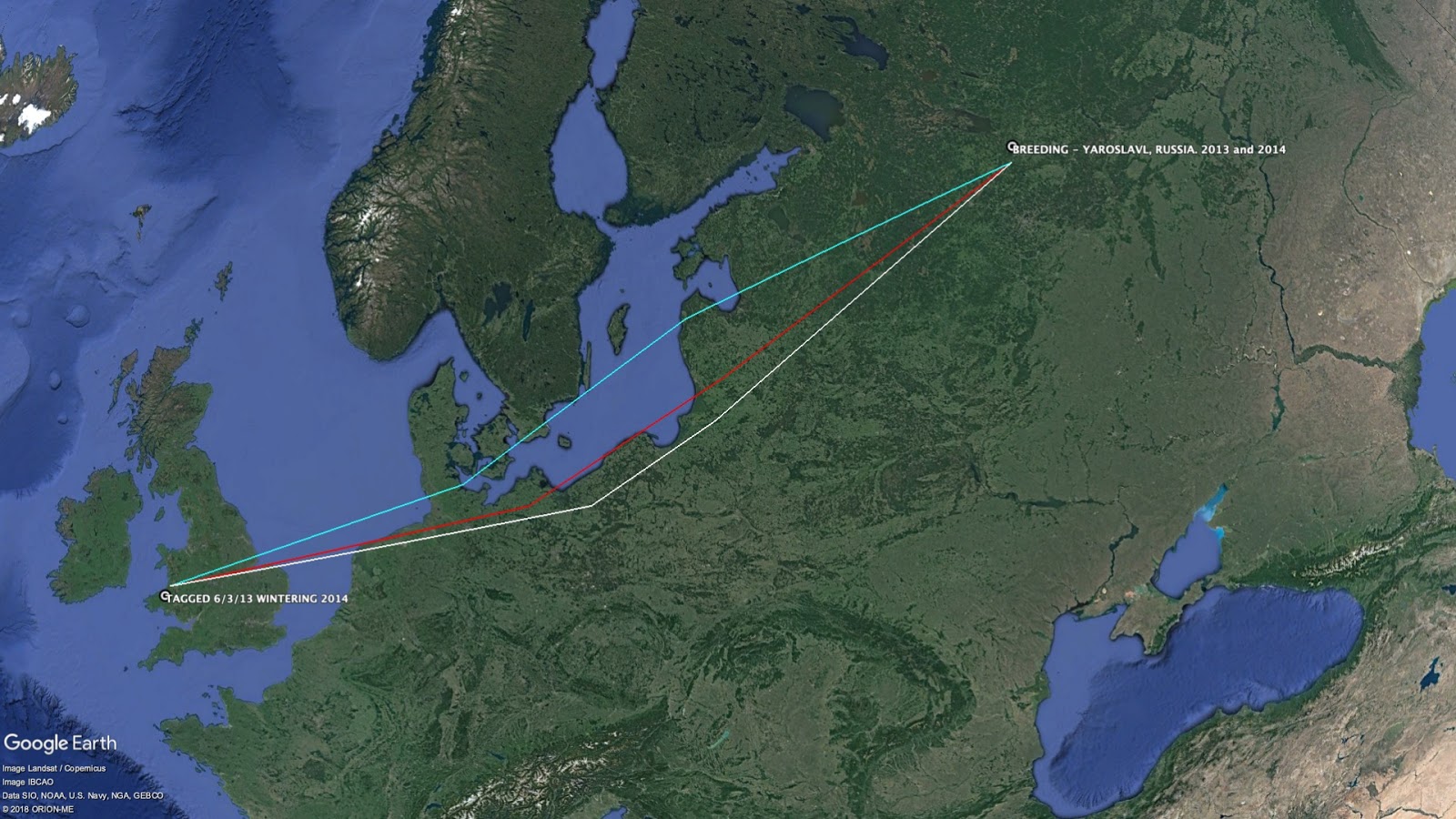
Woodcock migration tracked
We can only speculate how this Woodcock perished, however my ringing site is close to a tributary of the Ystwyth River that enters Cardigan Bay 9 km away and very close to the beach in Aberystwyth where the tag was found. There is no knowing when it perished, but it does appear that this tag has spent a considerable time immersed in water. The fact that the data was still accessible after all this time speaks volumes about the quality of design and engineering that goes into these tags.

21 December 2017

Return of the winter Blackcaps - a geolocator story

How do migratory birds respond to a changing environment? The answer to this question may help us unlock key insights into the mechanisms behind migration, and predict how animals will adjust to future global change. British Blackcaps may provide key insights into birds’ abilities to evolve changes in migration. Blackcaps are now spending the winter in the Britain and Ireland in greater numbers than ever before - a change BTO scientists have linked to garden feeding and warmer temperatures. But what exactly do they gain by wintering here, and where are they coming from?

Blackcap with first geolocator retrieved - photo by Benjamin Van Doren

As previously reported, last year, researchers from the BTO, Oxford University, and Exeter University began teaming up with bird ringers and garden owners across Britain and Ireland to study the Blackcaps that visit our gardens in winter. Last winter, we fitted 36 Blackcaps with geolocators, miniature devices that track movements throughout the year; however, the birds must be recaptured in order to retrieve the device and data, which can be a challenge.

Excitingly, returning Blackcaps carrying geolocators have been seen in gardens around the country since late November. These early successes would not have been possible without the dedicated BTO ringers, Garden BirdWatch participants, and other volunteers who have contributed so much time and effort to the ongoing study.

Blackcap geolocator movements. Blue dot - wintering site.

On 26 November, Glynne Evans recaptured the first returning individual in his Hampshire garden where it was tagged nine months earlier. Preliminary analysis indicates that the bird left Britain at the end of March and spent the summer in France, before returning by early November. But is this pattern the exception, or the rule? And why did this bird decide to come north for the winter when it was already in southern France? We hope to find the answers to these questions and many others - as the project continues.

Garden ideal for Blackcaps - photo by Benjamin Van Doren

Glynne’s GBW garden has turned out to be an exceptional Blackcap site, with a further tagged bird (analysis in progress) being caught in December, as well as two other colour-ringed birds returning from last year, giving a return rate of 25%, so far. We know very little about their behaviour and movements in winter, so any sightings of colour-ringed birds would also help answer these questions. Glynne provides food for Blackcaps starting relatively early on in autumn—could this partially explain their affinity for his garden?

How can you help? 

Do you have Blackcaps visiting your garden in winter? Look out for Blackcaps with colour rings and note the positions of the colours on each leg, or even better, take a photograph. Observers interested in joining the colour-ringing and tracking efforts can contact Benjamin Van Doren at Oxford (benjamin.vandoren@zoo.ox.ac.uk) or Greg Conway at the BTO (greg.conway@bto.org). Gardens with multiple Blackcaps regularly attending bird feeders are particularly valuable. For further information please see Life Cycle, issue 6 Autumn 2017.

This study is a collaboration between Oxford University, BTO, Exeter University and the Max Planck Institute for Evolutionary Biology, Germany.

13 September 2016

Who ringed the Plover?

The BTO Online Reports map for Ringed Plover shows a very broad distribution of recoveries of birds that visited Britain or Ireland at some stage during the year. By looking in detail at the time of year they were ringed and subsequently found, we can start to tease apart what is going on. Thanks to the Gulf stream making our shores relatively warmer than those further north, thousands of small waders winter here and some birds that have bred here move south to winter in France, Spain and even Africa.

Ringed Plover recoveries. Purple: ringed in Britain & Ireland, Orange: found in Britain & Ireland

At this time of year there will be a mix of birds moving south and birds that have just arrived. Telling the difference between these is where ringing comes into its own. As we have posted previously, Lee Collins spends hours throughout the year looking at birds' legs at Dawlish Warren. One of his recent finds included this colour-ringed Ringed Plover (below).

Ringed Plover - photo by Lee Collins
After a little searching it became clear that this bird was ringed 42 days previously at Dufour River, Byulot Island, Canada! This is currently the second report on our system of a Ringed Plover from Canada. This bird was ringed while 'he' had an active nest with eggs (which hatched two days later), so assuming they were not predated, he must have made a very quick trip to Dawlish Warren from Canada. He was one of 73 birds fitted with a geolocator. When these birds arrive back in Canada, and Don-Jean Leandri-Breton resumes his nest study, hopefully the retrieved geolocators will provide information on when and where these birds have been since the geolocator was added.

To get the full effect of how remote the ringing location is, just zoom out of the map below.


Photo taken by Don-Jean Léandri-Breton

Photo taken by Don-Jean Léandri-Breton


For more information see the Dawlish Warren blog.

05 August 2014

Overseas Goatsucker in Sussex


Recently we heard of a ring that had been found in a barn, we coded this as 'ring only found' as there was no bird attached to it. When adding the details to the ringing database, it was a nice surprise to see that the ring had once been on the leg of a Nightjar. But, even more interestingly was that this ring had been put on this Nightjar at Jews Gate, the ringing site of the Gibraltar Ringing Group, in the overseas territory of Gibraltar in October 2012.

It would would have been much nicer to receive news that this bird was still alive, but still we thought this was good enough to be mentioned, as the bird must have travelled from its wintering grounds, probably in southern Africa, to the UK at least once.

Nightjar - John Bowers

So this latest Nightjar is the first documented movement between the overseas territory of Gibraltar and the UK, and the second between the Iberian peninsula and the UK.

Found in the online ringing reports...

During the period 1909-2013, a grand total of 6,453 Nightjars have been ringed by ringers in the UK & Ireland, however only 222 of them have been recovered in that period. According to the ringing database, recoveries documenting the movements of Nightjars between the UK and other countries are not very many, 16 in total. Not susprisingly, movements between the UK and France are at the top of this category (11 birds), but there are other five movements between the UK and other countries worth mentioning: Algeria, Morocco, Spain and The Netherlands, which are shown in the map below (ringing and finding sites are paired up by the colour of the pin).


This latest report comes to confirm what our colleagues here at the BTO have revealed with the Nightjar Tracking Project. They were able to map the movements of a bird in a year-long trip across at least 16 countries with the use of a geolocator. They estimated that this bird travelled as far as the Democratic republic of Congo in a 19,000km round trip!


19 March 2014

Fabulous phalaropes

With so few birds breeding in the UK and even fewer ringed, it's not surprising that we have only had a handful of Red-necked Phalarope recoveries and none of these have been abroad. Very little is known about the life of these tiny birds when they are away from their breeding grounds on Shetland and the Western Isles, but thanks to cutting-edge technology we are getting some extremely interesting insights.

Red-necked Phalarope - Edmund Fellowes

Tiny geolocators, which record the bird's position by a combination of light levels and time, were placed on 10 Red-necked Phalaropes as part of a collaboration between the Swiss Ornithological Institute, Shetland Ringing Group and the RSPB.

Red-necked Phalarope and its geolocator - Adam Rowlands

After successfully recapturing one of the tagged birds a year after ringing, its geolocator was removed and the information downloaded. This revealed an amazing 16,000 mile migration across the Atlantic into the Labrador Sea, then down the east coast of North America to Florida. This bird then crossed Mexico and remained east of the Galapagos Islands in the Pacific Ocean for the winter. On its return in April it followed a similar but more southerly route back. This is the first time a European bird has been recorded taking this migration route.

Migration route of the tagged Red-necked Phalarope
The data gained from this one bird has revealed a wealth of information, not only of the migration route it took but also the timing of its migration and how long it remained at stop-overs. The project will continue to answer other questions including whether all of our breeding Red-necked Phalaropes take this migration route or do some birds join the Scandanavian population, and whether this route changes depending on the weather and local storms. This technology is improving very quickly so it won't be long before we know a lot more.

Thanks to David Okill for letting us know.

09 August 2013

Autumn migration underway

August is a great time to be out birdwatching and also ringing and nest recording. At this time of year birds including finches and pigeons are still nesting, but some have already finished breeding for the year and are starting to migrate, like our BTO Cuckoos. Waders start moving through our country at this time of year and we have had reports of Swallows starting to gather and Swifts leaving the country (graph below).

BirdTrack reporting rate for Swift

With the migration and dispersal of birds there are often interesting recoveries or sightings. Some recoveries from July include a Lesser Black-backed Gull ringed on the Isle of May, Fife in 1995 and seen in Spain (2170km), a Gannet ringed on Sule Skerry, Orkney in 2005 caught by another ringer in Iceland and a Spotted Redshank from The Netherlands had its ring read in Norfolk!

Gannet colony - Nigel Clark

One of the big stories was a sighting of a Balearic Shearwater being seen North West of Annet, Isles of Scilly. Not only is it the first ever report of a Balearic Shearwater wearing a ring in UK or Irish waters, but this bird was also wearing a small geolocator. To help save this critically endangered species, these loggers record the movements and behaviour of the bird while it is away from the breeding grounds. For more information on this data-logging project click here.

21 January 2013

Detailed Common Sandpiper movements discovered

We've had a number of recoveries of Common Sandpiper on migration and on the wintering grounds over the years including Algeria, Morocco, Italy and Guinea Bissau. The distribution can be seen on the map below (purple - ringed in Britain Ireland, yellow - ringing location of birds later found in Britain or Ireland).


However, we now have more information from a study by Highland Ringing Group ringers which investigated the pre-migratory change in mass and the migration route of Common Sandpipers in 2011. Some of these birds were fitted with geolocators in Highland, Scotland, which logged the approximate location of each bird using a combination of time and day length.

They write:
"One bird left Britain on 21 July and migrated for three days to Morocco where it staged before continuing its migration to W Africa for the non-breeding season, arriving on 29 July. The region in which it spent most of the non-breeding season (Oct–Feb) was S Senegal or The Gambia.
Prior to northward migration, the bird spent a period inland, before crossing the W Sahara desert to Morocco. Its migration was then delayed, probably due to adverse weather (strong NW winds). However, after a week in Morocco, which involved some northward movement, it followed the east coast of Spain and crossed to W France before moving through England to Scotland. Although Common Sandpipers can accumulate sufficient stores for a long single non-stop flight between N Europe and W Africa, the focal bird migrated in medium-range “skips” during both its southward
and northward migrations."

This is the first record of a British-breeding Common Sandpiper on its wintering ground south of the Sahara. The earlier record in Guinea Bissau referred to a bird on migration, so its origin was unknown.


Thanks to Brian Bates, Brian Etheridge, Norman Elkins, James Fox & Ron Summers for conducting this fascinating study. For more information on the International Wader Study Group click here.

10 June 2011

Nightjars and Lightbugs

Nightjars are now returning to the Forestry Commission's Thetford Forest and are pairing up ready to start nesting. Thetford Forest Ringing Group members were out on Thursday night in order to catch these birds to understand more about their movements on migration and particularly in their wintering quarters, as surprising little is currently known about this species. A first catch of four birds was a marvellous start to this new BTO/Biotrack project, supported by Shoreham & District Ornithological Society.

Unlike the Cuckoo, previously reported, the Nightjar is too small to have a Satellite transmitter fitted. Geolocator tags are an excellent alternative but we have to catch the birds again next year to download the information on their movements. These tags, known as Lightbugs, collect data on day length and time, which is used to calculate the bird’s global position to within 100km, each day. These daily locations will help reveal migration routes and wintering locations within Africa.


Just when you thought a near perfect night couldn't get any better, one of the females was discovered to be already ringed, RP01170. She was originally caught on migration, 171km away at Icklesham, Sussex on 15 September 1999 and we had not seen her since she was caught in the forest in 2008.

RP01170 has now broken the previous British and Irish longevity record, which stood at 11 years and 10 days, by 257 days. Amazingly, Brian Cresswell who helped fit the Lightbug to RP01170, originally caught the previous oldest Nightjar, in Dorset, back in 1992! So, quite a privilege to have handled the two oldest Nightjars in Britain and Ireland.

Thanks to Brian Cresswell and Forestry Commission for their valuable help and to Kate Risely for the photo (Lee Barber on left and Brian Cresswell on right).