Showing posts with label Gannet. Show all posts

27 February 2015

Eat like a Gannet

Along with all of the useful data coming into the Demography Team from the Nest Record and Ringing schemes, we also get some interesting or unusual reports. Our latest recovery from Dr Kees Camphuysen, Senior Scientist and Marine Ornithologist at the Nederlands Instituut voor Zeeonderzoek, is one of these:

"I was demonstrating a post mortem for Ecomare animal care staff tonight on an unringed juvenile female Gannet. It was originally found fresh dead on a beach on Texel, The Netherlands, in 2013 but was frozen to keep it in a fresh state until the post mortem."

Juvenile Gannet during post mortem - Dr Kees Camphuysen

"It was severely emaciated but this was not unusual of young Gannets at this time of year but I could feel a very lean and stiff "fish" in the stomach. It was not a fish however. It was a wing...a bird wing, heavily digested and the primary shafts suggested the bird was reasonably large. To my utter surprise, in the muddy blackish, digested remains was....a ring!!!"

The ring was put on a Fulmar chick on 4 August 2013 on Swona, Orkney by the Orkney Ringing Group. Considering this bird was found on 18 October 2013, this chick didn't survive very long. Kees and his colleagues believe the chick may have been eaten by a large fish, possibly a Cod, which was then caught by fishermen, gutted and the offal (including the remains of the Fulmar!) eaten by the Gannet. We will never know for sure what happened but it is very interesting nevertheless.

The contents of the Gannet including blackened feathers and ring - Dr Kees Camphuysen


06 March 2014

The wreck continues...

The storms battering western Europe may have abated somewhat, but the number of birds washing up on beaches across Spain, France, Ireland and Britain have not. There is usually a delay in the number of birds washing up after such events, but we are still hearing about large numbers of auks, Puffins and Shags on beaches.

We previously posted about the number of Puffins being found in France, but in he last week birds have been turning up along the west coast of Ireland and Britain. Statements such as "I found this ringed bird among 148 dead puffins on 900 meters of beach" are sadly common place.

Winter-plumaged Puffin
Gunwalloe Fishing Cove, Cornwall (Mark Grantham)
The number of ringed birds reported now stands at:
  • 124 Puffin
  • 104 Guillemot
  • 98 Razorbill
  • 75 Shag
  • 7 Gannet
  • 4 Black Guillemot
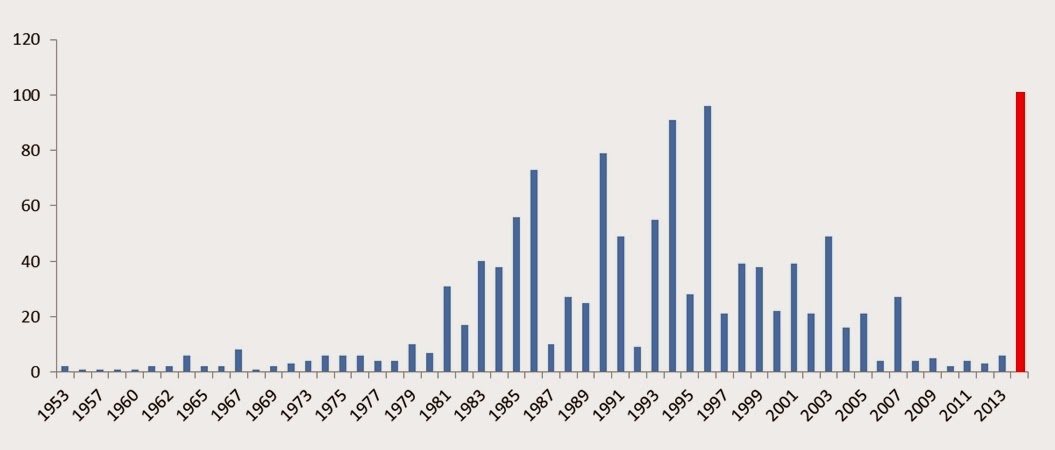
For the time of year, these are record numbers of both Guillemot and Puffin. Looking back at January/February recoveries of these birds, we can see just how unprecedented this current event is.

Number of Jan/Feb ring recoveries of Puffin
Number of Jan/Feb ring recoveries of Razorbill
Number of Jan/Feb ring recoveries of Guillemot

This will be a small fraction of the total amount of birds that have died (now well over 28,000 birds) but these ringed birds do tell us something about the birds affected. Many of the Puffins are from sites including Sule Skerry (40km west of Orkney), the Shiant Islands (Outer Hebridies), the Treshnish Islands (near the Isle of Mull), Great Saltee (off Co Wexford) and Skomer Island (Pembrokeshire).

Razorbill M91165 was ringed as a chick on Sanda Island in 1997.
It was one of 40 birds found at Watergate Bay, Cornwall,
on Valentine’s Day. © Newquay Beach Care

09 August 2013

Autumn migration underway

August is a great time to be out birdwatching and also ringing and nest recording. At this time of year birds including finches and pigeons are still nesting, but some have already finished breeding for the year and are starting to migrate, like our BTO Cuckoos. Waders start moving through our country at this time of year and we have had reports of Swallows starting to gather and Swifts leaving the country (graph below).

BirdTrack reporting rate for Swift

With the migration and dispersal of birds there are often interesting recoveries or sightings. Some recoveries from July include a Lesser Black-backed Gull ringed on the Isle of May, Fife in 1995 and seen in Spain (2170km), a Gannet ringed on Sule Skerry, Orkney in 2005 caught by another ringer in Iceland and a Spotted Redshank from The Netherlands had its ring read in Norfolk!

Gannet colony - Nigel Clark

One of the big stories was a sighting of a Balearic Shearwater being seen North West of Annet, Isles of Scilly. Not only is it the first ever report of a Balearic Shearwater wearing a ring in UK or Irish waters, but this bird was also wearing a small geolocator. To help save this critically endangered species, these loggers record the movements and behaviour of the bird while it is away from the breeding grounds. For more information on this data-logging project click here.