Showing posts with label guillemot. Show all posts

06 March 2014

The wreck continues...

The storms battering western Europe may have abated somewhat, but the number of birds washing up on beaches across Spain, France, Ireland and Britain have not. There is usually a delay in the number of birds washing up after such events, but we are still hearing about large numbers of auks, Puffins and Shags on beaches.

We previously posted about the number of Puffins being found in France, but in he last week birds have been turning up along the west coast of Ireland and Britain. Statements such as "I found this ringed bird among 148 dead puffins on 900 meters of beach" are sadly common place.

Winter-plumaged Puffin
Gunwalloe Fishing Cove, Cornwall (Mark Grantham)
The number of ringed birds reported now stands at:
  • 124 Puffin
  • 104 Guillemot
  • 98 Razorbill
  • 75 Shag
  • 7 Gannet
  • 4 Black Guillemot
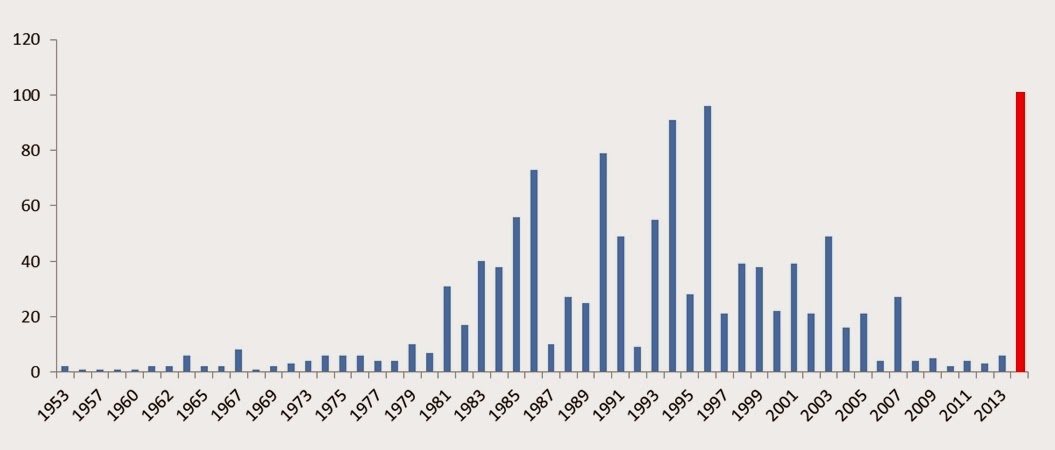
For the time of year, these are record numbers of both Guillemot and Puffin. Looking back at January/February recoveries of these birds, we can see just how unprecedented this current event is.

Number of Jan/Feb ring recoveries of Puffin
Number of Jan/Feb ring recoveries of Razorbill
Number of Jan/Feb ring recoveries of Guillemot

This will be a small fraction of the total amount of birds that have died (now well over 28,000 birds) but these ringed birds do tell us something about the birds affected. Many of the Puffins are from sites including Sule Skerry (40km west of Orkney), the Shiant Islands (Outer Hebridies), the Treshnish Islands (near the Isle of Mull), Great Saltee (off Co Wexford) and Skomer Island (Pembrokeshire).

Razorbill M91165 was ringed as a chick on Sanda Island in 1997.
It was one of 40 birds found at Watergate Bay, Cornwall,
on Valentine’s Day. © Newquay Beach Care

22 April 2013

Tough times for sea birds

As you heard in a previous post, we have been receiving large numbers of reports of dead or dying Barn Owls. What we didn't mention is that we are also receiving reports of large numbers of dead seabirds on the east coast of Scotland and northern England but also as far south as East Anglia.

The majority of these birds have been found in the Firth of Forth, Scotland, and this seabird wreck has occurred at a time when these birds should be getting into prime condition for the breeding season, or even nesting now. High winds and 'uncomfortable' sea conditions are thought to be the prime cause, making finding food difficult.

Colour ringed Shag - Sarah Featherstone

The majority of reports of ringed birds have been Shag but have also included a wide variety of species, including Puffin, Razorbill, Guillemot, Kittiwake, Cormorant and even Little Auk. The graphs below show the 10 year average of reports (blue) against the number of reports so far this year.


You can clearly see the huge difference between early and late March. The number in early April is slightly less than late March and early indications show that late April will have many fewer reports of dead shags, as long as the trend continues.


 We receive very few recoveries of dead Puffins generally during the winter period but this year in late March we can see evidence of the wreck.


Strangely, Guillemots have fared very well, considering the previous two species, with a lower than average report rate. Although there have been large numbers of Guillemots washed up in Cornwall and Devon from a synthetic chemical called polyisobutene. Surprisingly only nine dead and two live Guillemots (which are yet to show in the graph above) have been found ringed out of a minimum estimate of 1500 dead birds.

23 November 2009

From Norway with love (and to Norway...)

We received details back of two excellent recoveries involving Norway this last week - one to and one from...

One was the arrival of only our fifth foreign-ringed Marsh Warbler, which was caught at Cape Clear Bird Observatory, southwest Ireland, on 25 September (photographed below). It had originally been ringed in Rogaland, on the southwest coast of Norway, on 3 September - a hefty 1,269km from Cape Clear! Our other foreign-ringed Marsh Warblers have come from Norway (recaught at Fair Isle Bird Observatory in May 2007 and also a Suffolk bird we blogged in June), Denmark (found dead on Orkney in June 1979) and Belgium (recaught in Hertfordshire in June 1994). It is odd how all these movements are mid-summer ones, with only this recent one breaking the pattern...


The second was an excellent bit of photography by Haavard Eggen from the Norwegian Institute for Nature Research. His amazing flight shots of a Guillemot (below) allowed us to easily read the bird's ring number (X95104). It was photographed on the tiny island of Hernyken in northwest Norway (at 67 degrees north) on 21 July and had been originally ringed as a chick at Sumburgh Head, Shetland, in July 1999.


This movement isn't quite as exceptional as the Marsh Warbler though, with 1,161 BTO-ringed Guillemots previously found in Norway...

Thanks to Tycho Anker-Nilssen for sending on the Guillemot photos and to Michael O'Donnell for his Marsh Warbler photo.

22 September 2009

Mystery ring...

Found on the beach Carnsore Point, Wexford, on 17 September, this ring was a bit of a mystery at first.Many birds are colour-ringed to follow their movements, but without a species was this of use?


The giveaway is the unique, flattened shape of the ring, perfect to fit the leg of something like.... an auk. This is exactly what it turned out to be - a Guillemot ring. It was from a chick ringed (also with BTO ring number N03971) on Skomer Island, South Wales, on 26 June, so it hadn't survived too long.

All sightings of colour-ringed birds can be reported online at www.ring.ac so keep your eyes peeled!

Thanks to Tony Murray for the finding details and Tim Birkhead for the ringing details.