24 July 2020

What makes for a long life?

Rob Robinson writes:

I am sometimes asked the question: “How long do birds live?” The answer is, as to many good
questions, “It depends”.

The oldest known wild bird is a Laysan Albatross called Wisdom who breeds on the very remote Midway Atoll in the Pacific Ocean and is around 70 years old. The oldest known bird in Britain is a Manx Shearwater from the island of Bardsey in north Wales that was over 50 years old when last seen back in 2008 (more on that in a bit). The reason we know this, of course, is because both of  these birds have been ringed, so we can follow them as individuals. In fact our shearwater outlasted both the original ring and its replacement, so was on its third ring when last caught!

Manx Shearwater. Photo by Lee Barber

Not all birds live so long, clearly; the longest-lived Blue Tit, by comparison, was last seen a few months short of his 10th hatchday. The graph below shows the longevity for each species ringed in Britain and Ireland. But measuring longevity in this way is tricky; to get an accurate figure we  generally) have to catch the bird to fit a ring in the year it was hatched, and then the individual has to be found shortly after it, sadly, dies (these are marked by squares in the figure). This happens rather rarely – Carrion Crow (at 21 years) is one example, but you can see there are relatively few other squares on the graph. More commonly, we catch the bird as an adult so don’t know when it was hatched (the downward-pointing triangles), or the individual is caught/seen before it dies (the upward-pointing triangles), or, sometimes, both (the diamonds on the graph). So the Manx Shearwater was first caught in 1957 as an adult (so at least five years old already, possibly more) and then seen every few years until its last capture in 2008, but we don’t know when it died; we only ‘knew’ it for part of its life.

The oldest ever Manx Shearwater, then, is (was or will be) certainly in their late 50s and possibly into their 60s. This highlights another issue with longevities, these individuals are, by their very nature, exceptional, and so few and far between (think how many people live beyond 100, for example). We also have to wait, sometimes for many years, before we can get a fair estimate. Goosander on the graph is a good example: we know the age of HW37685 fairly well, he was ringed as a nestling, and we know when he died (aged 9 ½), but only 10 or 20 goosanders are ringed each year, so the chances of someone ringing (and then finding) the oldest, or even close to the oldest, bird are pretty slim.

Fortunately, we have a better way of measuring longevity, through a measure known as annual survival, which is simply the proportion of individuals that make it from one year to the next; it is the flip-side of mortality. As the graph shows, and one should expect, there is a strong relationship between annual survival and overall longevity.


Species that tend to live longer have higher annual survival rates. Points are coloured by body size and the shape indicates whether the longevity of the individual is fully known. Squares represent a bird ringed as a nestling/juvenile and subsequently found dead. Pointed shapes indicate uncertainty in age, either at the beginning (downward-pointing) or end (upward-pointing) of the bird’s life.

While a few Blue Tits can live as long as 10 years, most do not. In fact, our ringing data show that the annual survival rate of an adult is 0.53. This means that for every 100 adult Blue Tits starting the year, 53 will make it to the end or, conversely, that 47 of them will die at some point during the year. It is worth just stopping for a second and reflecting on what this means out there in our gardens and woods. At last count, there were approximately 3.4 million breeding pairs of Blue Tits in Britain, so 7 million individuals, near enough. A survival rate of 0.53 implies that, in the normal course of things, around 9,000 Blue Tits die, on average, each day (7 million * 0.47 / 365); that’s about three in each and every 10 km square every day. Adding in young birds will, of course, make this figure much higher in the summer. The balance of productivity and survival is important then, since each of these birds needs to be ‘replaced’ if the population is to remain stable in size.

An alternative way of expressing survival is life-expectancy. In the Scottish play, Shakespeare reckoned on living “threescore and ten”, i.e. 70 years (a figure that, in fact, dates back to biblical times, although recently is more like 80 years in developed western countries but nearer 50 years in countries like Afghanistan and Somalia). Broadly, life expectancy in birds varies by size - heavier birds, marked by darker colours, fall more on the right side of the graph, lighter birds, in both colour and mass, to the left. Most small birds, like the Goldcrest, that fledge will not survive to breed. That is, their life-expectancy is less than one year; being a young bird is hazardous indeed! At the other end of the scale, Mute Swan cygnets have a reasonable expectation of making it into their early teens.

The graph shows how most birds cluster about an average line; as survival increases so does the recorded longevity. (The line curves sharply upwards on the right simply because, numerically, survival cannot be greater than 1.) Species that fall well below the line (like Lesser Spotted Woodpecker and Capercaillie) are ringed in such small numbers that we simply don’t have a good estimate of their total longevity yet; in future years these points should rise to become closer to the line. All the conservation effort that has been put into looking after Red Kites, probably means the longevity of that species is a bit higher than it might have otherwise have been. For Wigeon, on the other hand, the annual survival is much lower than we might expect from their longevity because they are hunted over much of their range, the point is well to the left of where it might otherwise be. This leads us on to the main reason why knowing about survival rates is interesting, and why ringing individuals is such a powerful tool.

By measuring how survival varies in different places or times we can understand how and why populations change. By and large, adult survival usually does not vary very much – we find it is pretty consistent between places and over time. When it does change though, the effects can be dramatic. The decline of the Lapwing (see figure) was caused, in large part, by a run of cold winters that made it hard for birds to find food. The population hasn’t recovered, though, not because survival rates have stayed low (they bounced back), but rather because the number of chicks that can be produced in Britain’s intensively managed landscapes was too low to replace those that succumbed. Similarly, the population of Oystercatchers on the Wash (and elsewhere) is sensitive to reduced survival caused by over-harvesting of cockles and mussels, a fact which is now taken into account in managing the shellfisheries there. More often though, it is the balance of survival and productivity that is key, as we see in the decline of Willow Warblers in England and understanding this balance is key to designing effective conservation measures.

Survival of lapwing (purple dots, with 95% confidence limits) was reduced during a period with cold winters (blue arrows) causing a decline in the breeding population (green line, shading indicates 95% limits) in the 1980s. Redrawn from Robinson et al. (2014).

So. What does make for a long life? Certainly if you are a bird being larger helps, and the ringing report shows that all the longest-lived birds are seabirds. But what I hope I have shown is that while the longest-lived individuals are interesting, ringing tells us more about how well the average individual does, and this is why the efforts of ringers are still important. Although tracking studies are producing fascinating new insights virtually every week, the number of birds tagged (or likely to be tagged in the near future) will generally not be sufficient to help us measure survival of birds across the population. Ringing remains the only way to do this, and will continue to be a vital tool in understanding and managing our bird populations for years to come.

If you find a dead bird with a ring on, even one that has hit a window or been brought in by your cat, then you too can contribute to our monitoring of survival. Please tell us by filling out the details at www.ring.ac. There is more information on where birds go, what happens to them and how many birds are ringed in each county on our online ringing and nest recording reports.

22 June 2020

Where will they tern up?

Rachel Taylor, Steve Dodd and Katharine Bowgen write:

Many of you will already have heard the news that the Skerries tern colonies have been almost completely abandoned this year; an event thought to have been triggered by predators colonising the islands; which in a normal year would likely have been managed by RSPB colony wardens. Sad though an event like this appears, it isn’t all that uncommon for colonial seabirds to move around; and entire colonies have been known to disappear and recover over time. What’s different about the Skerries is that recent colour-marking work provides an opportunity to understand the demographic processes behind this huge event – and birdwatchers can be a key part of the work.
 
The Skerries helipad. Photo by Rachel Taylor

The Skerries are a group of rocky islands in the Irish Sea, near Holyhead on Anglesey, owned by Trinity House. The significant seabird colonies are managed, protected and monitored by RSPB.

The Arctic Tern colony is the largest in the UK, with 3,816 pairs in 2016 - along with 290 pairs of Common Terns and an increasing probability of breeding attempts by Roseate Tern – in 2018 fledging two chicks for the first time in decades. In a normal year the terns arrive early in May, with hatching starting at the beginning of June and the first chicks fledging in early July.

Leg-flagged Arctic Tern on The Skerries image by Rachel Taylor

Since 2013, RSPB has supported local ringers Steve Dodd and Rachel Taylor in running a set of small demographic projects in the colonies on Skerries. A sample of 500 Arctic Tern chicks are ringed each year, and Retrapping Adults for Survival (RAS) studies run on both Arctic and Common Terns. The RAS studies use individually coded leg-flags to identify individuals. There are several good reasons why RSPB supported our work, but one major justification was an interest in understanding colony dynamics in terns.

Colonial seabirds in general have something of a dilemma in choosing a nest site. Colonies have advantages: for example in recognising and exploiting local resources like safe sites for nests, and good feeding sites. Individual nests run a lower risk of loss to predators, because there are many nests to choose from, and many eyes watching for those predators. But they also create problems – such as risk of disease transmission, increased competition for food resources, and vulnerability to local resource changes, random disturbance events and becoming a target for predators. Major colony collapses may be a result of several pressures operating at once. But terns are long-lived; several studies have identified the linked nature of adjacent colonies, with large colonies exporting chicks to smaller sites, and local populations remaining broadly stable despite rises and falls in breeding numbers at individual sites. Site abandonment tends to be more-or-less temporary, and if the pressure that caused the birds to leave is managed or removed entirely, the birds return.

Leg-flagged Common Tern 'CJ' in The Skerries. Photo by Rachel Taylor

When we set up the adult survival projects on the Skerries, we knew that most large colonies north  of Anglesey had at some time in the past, experienced significant population declines or abandonment – one of the most dramatic being the abandonment of the Shotton Steelworks Common Tern colony on the Dee in 2009. The reasons for that collapse, and the work underpinning the colony’s subsequent recovery, provide a fascinating example of the complex issues that long-lived seabirds experience. But we wanted to know some very specific things about the birds’ experience of a ‘colony collapse’ event. Of course, at the time the Skerries colony was going from strength to strength and we expected that to continue; but the national pattern was clear. We could learn from adult survival data in a healthy colony, but would also be prepared with a good  baseline in the event of something changing for the Skerries.

We had a specific set of ‘in-the-event’ questions. Firstly, since Arctic Terns are more site-faithful than Common or Sandwich terns, would a colony-breaking event cause them to simply take a year off and then return the following year, or would they immediately try somewhere else? Secondly, having attempted (and possibly been successful) elsewhere, would they return to the Skerries in subsequent years, or emigrate for life? Thirdly, terns are reluctant to change their breeding site for very good reasons; we wanted to understand the survival implications of the birds experiencing such a major upheaval as a colony collapse event. Survival studies take time, and like dispersal studies, depend on birds being individually recognisable without causing data-skewing and inappropriate disturbance – hence the common use of colour marking in RAS.

Lots of terns. Photo by Rachel Taylor

The collapse of the Skerries tern colonies this year is very sad, but certainly isn’t the end of the story. There is good evidence that such a collapse will be temporary if – as already seems likely - the cause is identified and can be managed. But more than that, the Skerries is a huge opportunity to learn about collapse events, and about how individual terns respond and recover from them. Birders are already beginning to look for birds from the Skerries, marked with coded orange (Arctic Tern) or yellow (Common Tern) leg-flags. In particular, the nearest colony on Anglesey (Caemlyn) has already seen an influx of Arctic Tern, and the wardens are on the lookout for marked adults. If you live or bird around the coasts of NW England, North and Mid Wales or the Isle of Man, or the Irish Sea coasts of the Republic of Ireland and Northern Ireland and if Government restrictions allow, please keep your eyes peeled and your bins poised – and help us find the scientific silver lining inside the dark cloud of this year’s Skerries colony abandonment.

Flag sightings to sg.dodd@yahoo.com

15 April 2020

The joy of garden nesting

BTO Scotland’s Steve Willis and BTO Northern Ireland’s Stephen Hewitt share their passion for monitoring garden nests and pass on some tips for how to get involved in this rewarding activity.

NOTE: If you are new to nest monitoring and want to record the progress of a few garden nests and nest boxes then Nesting Neighbours is the ideal interface - it’s simple to use and provides some really nice feedback on how other people’s nests are doing too. If you already use Demography Online (as a ringer or Nest Record Scheme participant) then please continue to do so, signing up to NRS if necessary. The data from both systems go into the same underlying database and contribute to the statistics. These schemes collect information on breeding success which helps us to understand the impacts of factors such as climate change and food availability on the number of young produced, and the influence this then has on population trends. Participation is therefore very valuable as well as rewarding. Scientific studies have shown that, as long as observers are careful and follow the BTO's Code of Conduct, making several visits to a nest to record the contents does not increase the probability of it failing. It is completely legal to look inside a nest in England, Scotland and Wales as long as you do not touch the contents and the species is not included on the list of scarce protected birds. If, like Stephen, you are in Northern Ireland or the Republic of Ireland, you must apply for a licence prior to monitoring a nest of any species. A separate licence is needed for photographing nests.

Steve: Since the Covid-19 lockdown, like many people I’ve been working from home. My home office has a view out over the garden, and I started noticing a female blackbird regularly visiting a particular evergreen shrub in the shade of a big holly tree. It looked like she was building a nest! I was aware of the Nesting Neighbours project and I wondered if I should give it a go, though I must admit I hadn’t done any nest monitoring before. A chat with Stephen (who is an old hand and infectiously enthusiastic) had me sold! I had a read of the guidance pages and then went out to take a look…

The Blackbird nest is in the coniferous shrub in the centre of the picture (Steve Willis).

The nest was about one metre off the ground in a dense coniferous shrub so to look down into it I needed to very carefully move a few small branches apart. Peering inside, I could see four beautiful speckled blue eggs! It felt like such a wonderful privilege to be getting such a close view. The female was off the nest at the time but I could hear the male singing somewhere nearby. I beat a hasty retreat and watched from the kitchen window. Reassuringly it wasn’t long before the female returned. I visited the nest again a few days ago - five days after my first visit - and this time the female was sitting tight, obviously incubating. I think I’m getting the hang of it!

I’m under strict orders from Stephen to follow the breeding attempt through, whatever happens. Nests fail naturally for a number of reasons, including predation, and this is a regular occurrence with early thrush nests. Information from all breeding attempts is important, not only the ones that succeed.

These Blackbird eggs are a beautiful speckled blue, but the colours can vary a bit (Steve Willis).

When I’m not doing various bird-related things, I enjoy a bit of woodwork, and although I already had one nest box up in the garden, I was inspired to make another out of some odds and ends. Here’s a short video of the build process. I might have put it up too late for anything to use it this year, but fingers crossed! If you want to have a go at building your own, the plans are here!

Stephen: Steve’s right, I am an old hand (though not that old, Steve!). I first got into nest recording about eight years ago when encouraged by the then BTO Northern Ireland Officer Shane Wolsey and Carl Barimore from BTO HQ. In a normal year I make regular visits to local patches in County Armagh. I absolutely love the process of searching for nests, tuning in to the subtleties of bird behaviour, song and call, and getting to know the types of places that different species favour. Every nest I find gives me a wee buzz and following a breeding attempt through to fledging is very satisfying! Of course it doesn’t have to be tricky at all - if you have tits nesting in your bird box then ‘nest finding’ is very straightforward!

Here’s a Song Thrush nest that I found. Note the hard, dry inner lining (like chipboard). The holly berries round the rim are a bit unusual, but apparently thrushes do occasionally decorate their nests (Stephen Hewitt).

I’d really encourage anyone who is considering garden nesting to give it a go. It is hugely enjoyable - absolutely - but remember you’ll also be collecting priceless information. By recording the number of eggs, fledglings and the outcome of nesting attempts, volunteers are helping to reveal how our wild birds are doing every year.

Many people start with a box, and monitoring these is straightforward if you have a nest box camera installed or if the lid can be removed. Just check the box every five days or so - easy! Before opening the box, give it a gentle tap to let anything inside know that you are coming, and then lift the lid just enough to see inside. Make a note of what you can see but take care never to touch eggs or chicks - if there is a bird incubating then simply replace the lid and come back later to count the contents. There are guidance notes here which give more detail.

If you enjoy nest monitoring (and I’m sure you will!) I’d really encourage you to ‘graduate’ to open nests, too. They are easier to find than you might imagine. You can sit quietly and watch the adults like Steve did, or carefully search trees, bushes and ivy. There are few things that compare with the thrill of pinpointing an open nest. Peering into a Dunnock’s nest at five recently-laid bright blue eggs takes some beating and provides vital information to help us understand how well this amber-listed species is breeding!

A Dunnock nest found by Stephen, near Lurgan, Co. Armagh in 2018.

Nest monitoring is a fantastic way to learn about bird behaviour, too. You’ll get to know the characteristics of each species, and you might notice differences between pairs. A particular male might have a characteristic song, with repeated phrases or mimicry. Some males sing throughout the breeding attempt, even whilst carrying food (male Blackcaps sometimes sing quietly while incubating!), whereas other males go very quiet once paired. Female behaviour can be interesting, too. They sometimes seem agitated when their eggs are about to hatch, giving repeated alarm-calls, even when seemingly undisturbed.

Nesting also throws up interesting questions; for instance why do female Song and Mistle Thrushes sometimes decorate the rims of their nests with berries and petals (see photo above)? And why would a female Whitethroat choose one of the decorated nests built by her mate, only to remove the decoration before laying?

Typically I monitor around 100 nests each year (my record is 117!) and for that reason I submit my data via the Demography Online interface. If you’re monitoring more than about twenty nests per year then this is probably the way to go, but for a smaller number of nests the Nesting Neighbours platform is ideal.

So there you have it - garden nest monitoring is really rewarding, hugely valuable, and you’ll learn a lot about ‘familiar’ birds through doing it. Go on - give it a go!

20 February 2020

It's National Nest Box Week!

It is National Nest Box Week (NNBW) this week and our wild birds are starting to think about the coming breeding season. This year is the 20th year of NNBW, which aims to encourage everyone to put up nest boxes for birds and to raise awareness of their needs ahead of the breeding season. While our migratory birds are preparing for their journeys back to Britain and Ireland for the summer, lots of our resident species are already singing to affirm their territory, finding a mate and choosing a nest site.

Tiny Blue Tit chicks thinking food has just arrived. Photo by Lee Barber

Around half of all households feed birds, so while food can often be plentiful, the lack of suitable nesting sites can be a problem. Putting up a nest box can therefore provide a welcome boost for some species. Blue and Great Tit are the most-frequent users of nest boxes but there is an amazing variety of species that use boxes, and by providing a suitable box, you could encourage them to set up home in your garden. House Sparrow, Nuthatch, Starling, Swift, Stock Dove, Tawny Owl and Kestrel are among the species that need suitable nesting sites and providing a box could really help them and some of our other declining red or amber listed species. For more information on what boxes are suitable for which species, click here.

Tawny Owl chicks waiting for the next delivery of food. Photo by Lee Barber

When buying a nest box, one of the most important features that I look for is a removable lid. This aids cleaning the box at the end of the breeding season (cleaning can be done between 1st September - 31st January) but most importantly it means that the contents of the nest can be recorded. BTO volunteer Nest Recorders around Britain and Ireland record the number of eggs, fledglings and the outcome of nesting attempts, providing a wealth of information on how our wild birds are doing every year. Nest recorders are provided with a code of conduct to make sure that the nest is checked in the safest possible way, so valuable information is gathered without affecting the birds.

BTO nest recorder checking on a Blackbird nest. Photo by Lee Barber

Nest cameras are a very popular choice and this also means that you can record the contents without even leaving your living room. They are particularly useful for boxes which are usually placed quite high or are difficult to get to, like Tawny Owl and Swift.

So far this year we've only seen a few birds inspecting our boxes at BTO HQ in Norfolk. Nest recording isn't just about those species that use boxes though; there are already a few Collared Doves sitting on eggs and we've also seen a brood of Egyptian Goose goslings paddling up the river. It's only a matter of time before we find our first Blackbird nest of the year and then the tit species will start building. It's a very exciting time!

Egyptian Geese are one of the earliest breeders. Photo by Lee Barber

For more information on becoming a nest recorder, check out our Nest Record Scheme website.

19 December 2019

A beach discovery provides more than just a ringing recovery

Owen Williams writes:

I can clearly remember the day I made my first ever retrap: it was 1 March 2008 and I was nearing the end of my training for a Woodcock-specific C permit with my trainer and award-winning ringing guru, Tony Cross. Over the following 11 years I have ringed over 1,800 Woodcock and fitted 60 geolocators on this same site in West Wales - the geolocators were part of the research project by the Game and Wildlife Conservation Trust (GWCT) into Woodcock migration. Recoveries of geolocators are always a massive bonus and my first was on 7 January 2013 when I retrapped a bird that had been tagged during the previous winter whilst the BBC’s One Show was filming a piece about Woodcock on my site.


A tagged Woodcock. Photo by Owen Williams.

Since that exciting night, a further 15 geolocators have been recovered, this represents a 23% recovery rate showing the remarkable site fidelity of the species. However the latest recovery must rank as one of the most unusual ever.

On 20 October, I received an email from Tony Cross informing me that Mark Carter, the former assistant warden on Bardsey Island, and ringer, had found a tag washed up on Aberystwyth beach and asking if I recognised the serial number shown in the photograph attached to his email. If the incredible luck of the tag being found on a shingle beach is not enough, to be found by a person who actually knew what it was and then knew who to ask about it, is truly amazing.


The tiny tag found on the beach. Photo by Mark Carter
I instantly recognised the serial number, confirming it was one I fitted on 6 March 2013. So it was promptly sent to Dr Andrew Hoodless who heads up Woodcock research at GWCT. He then sent it to James Fox at Migrate Technology Ltd the company who made the tag.

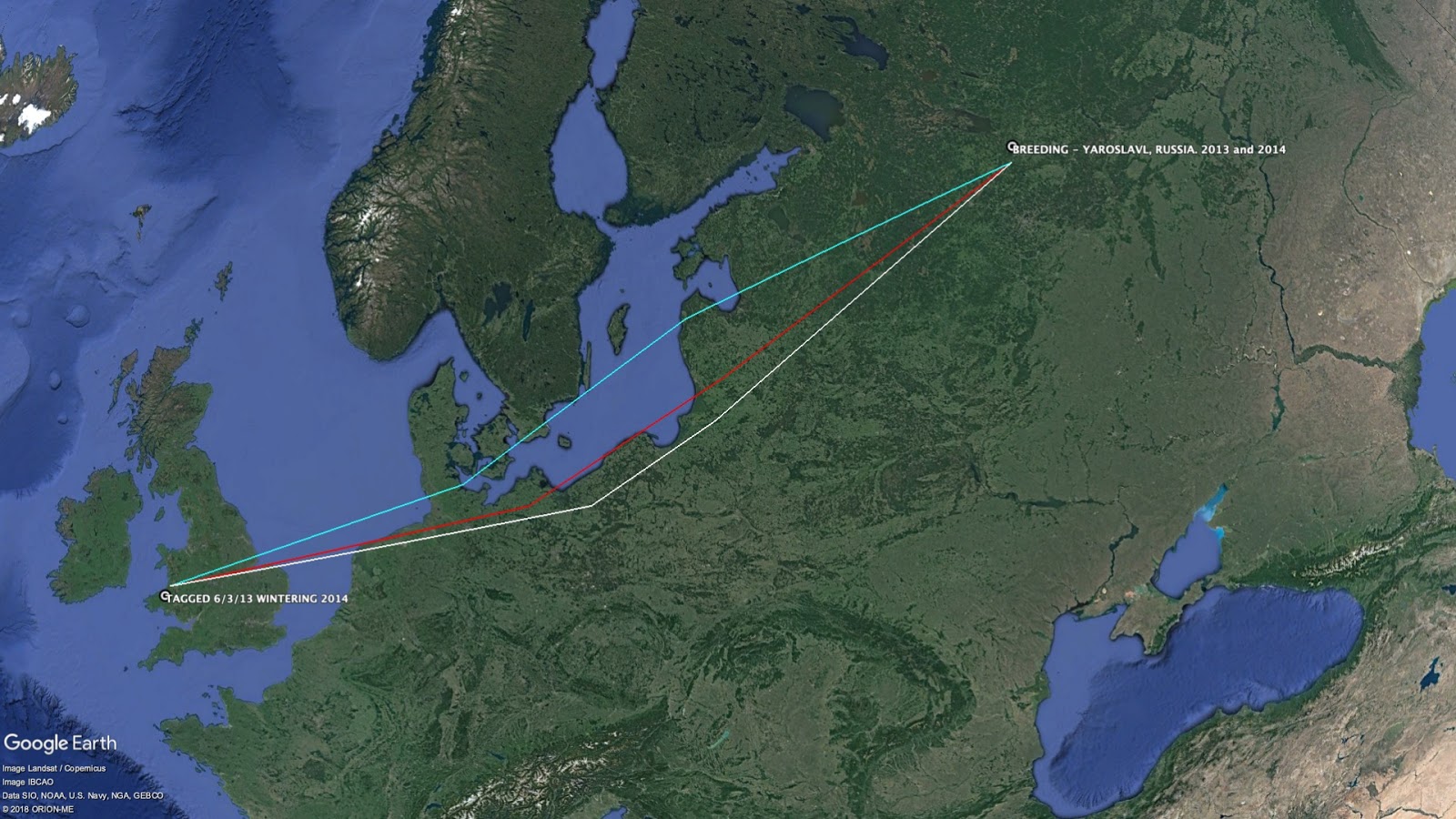
There then followed a nervous few weeks whilst we waited to find out if the tag still contained viable data despite being immersed in water for what appears to be a considerable time. The good news arrived on 10 December, when we learned that the geolocator had recorded 18 months of data before the batteries eventually ran flat. The data showed that this Woodcock had made three migration flights between West Wales and Yaroslavl in Russia, each journey being around 2,800 km. The tag ran out of power prior to this Woodcock’s autumn migration bringing it back to Wales, which means that it made a minimum of four migration flights since being tagged.

All the birds I tagged in 2013 were retraps of birds ringed in previous winters; this was because we knew that these were site faithful thus increasing the chances of encountering them back on the site in a subsequent winter and recovering the tags. This particular bird had been ringed as a juvenile by me in the previous winter, so had already made three migrations before tagging, with a minimum of four additional journeys before it died; this Woodcock must have flown at least 19,601 km since hatching. It is possible that this individual could have migrated for several years between the tag batteries running flat and the bird perishing, so it could have traveled even further than this.  

Woodcock migration tracked
We can only speculate how this Woodcock perished, however my ringing site is close to a tributary of the Ystwyth River that enters Cardigan Bay 9 km away and very close to the beach in Aberystwyth where the tag was found. There is no knowing when it perished, but it does appear that this tag has spent a considerable time immersed in water. The fact that the data was still accessible after all this time speaks volumes about the quality of design and engineering that goes into these tags.

03 December 2019

Moroccan farewell to a long-distance Peregrine

Ed Drewitt and Luke Sutton write:

For the past 21 years, Ed Drewitt has been studying urban-dwelling Peregrines around the Bristol area, in particular what they eat. His prey studies have revealed that not only do urban Peregrines eat a huge range of species in Britain (over 100) they also hunt at night catching nocturnally migrating birds such as Woodcock, Snipe, Teal, Moorhen and even Corncrake and Spotted Crake. During this period Peregrines have extended their range across southern England and can now be found nesting in most cities and large towns in this region.

Juvenile Peregrines blue RX and RY, RZ. Photo taken by Robin Morrison.

Since 2007, Ed alongside Luke Sutton, Hamish Smith, Seb Loram and Jason Fathers have been fitting blue colour rings to Peregrines across the west of the country from Bristol to Devon, ringing over 200 Peregrine chicks. They have received information on 55 of these birds, some of which were dead, others alive and well. Over this time the team have also submitted over 160 nest records for Peregrines, tracking both the highs and lows of their breeding attempts.

Peregrine blue RY being ringed. Photo taken by Robin Morrison.

One bird AA, the first the team ringed, is still the breeding male in Bath where he hatched and is now over 12 years old. Most recoveries (47 in total) are what we would expect, with females travelling further than males, and only 7% travelling further than 200 kilometres. It was therefore to the team’s surprise that blue RY, ringed on the 30 May 2019 in Taunton, Somerset, was found dead in early November in Tiznit, Morocco (2,435km over 155 days). He was hit by a vehicle. This is the first British-ringed Peregrine to make it to mainland Africa, beaten only by one that made it slightly further south to the Canary Island of Lanzorote.

Peregrine blue RY taking to the skies. Photo taken by Robin Morrison.

While Peregrines from northern Europe, such as Finnish Lapland, sometimes make it to northern Africa, this remarkable recovery illustrates the species' ability to travel long distances, which is does regularly from North America to Central and South America, and northern Russia to the Middle East. However, British-hatched Peregrines generally stay within the Britain or hop modest distances over to Belgium, France or the Netherlands.

04 April 2019

Thermal tech lightens the darkest nights

Ben Dolan writes:

In Spring 2017, we were privileged enough to be invited by the BTO to write an article for Issue 5, Spring 2017, LifeCycle magazine on the use of thermal imaging to monitor and ring birds ‘Thermal Birding’. This followed a successful trial, using it to find and ring lapwing pulli, and then using it whilst dazzling, which was a game changer in this area of ringing for us.

Woodcock found by the use of the thermal imagining device. Photo by Ben Dolan

At the time we were using the Pulsar XQ50S; we now use the Pulsar Helion XQ38F with streaming and recording facility.

Since the article was published we have been contacted by many BTO ringers, ringers from Europe and a couple further afield and have had some great feedback that using the device has reduced disturbance, made time more productive, made it easier to carry out bird counts, that surveying wildlife has never been easier and that people have had some first records for their sites using this method.


The view through the thermal imager, catching a Woodcock. Photo by Ben Dolan

Many ringers now own these thermal units and we have had the pleasure of hosting a number of ringers at our sites, as well as visiting theirs, and sharing knowledge which has been a great experience and has helped build new friendships and useful contacts.

The thermal imager is a fantastic tool for bird ringing, finding nests and monitoring nest boxes but it is also great for general wildlife surveys, whether it is hares, badgers, bats, moths and more.

Hedgehog. Photo by Ben Dolan

We look forward to continuing to share our experiences with others and hope they have as much success with the equipment as we have had, with some equally surprising records.

To keep up to date with what we do please follow us on twitter @ringerswm or for our thermal technique guide, visit our website www.westmidlandsringinggroup.co.uk

05 March 2019

Crappy place to ring

Matt Prior writes:

You wouldn’t normally think of sewage treatment sites as wildlife havens but they are often sought out by bird ringers because they are indeed very attractive to birds. A particular treatment process, percolating filters, are rich with fly larvae, worms and snails that graze on the bacteria that treat the sewage. Sewage works are particularly beneficial to birds in the winter providing an insect food source during cold weather because the filters rarely freeze due to the warmth of the sewage. Accessing such sites is difficult and requires robust risk assessments and method statements and ringers have to take the unusual steps to wear full personal protective equipment including hard hats and high visibility clothing.

Sewage treatment works in the snow. Photo by Lee Barber

Grey Wagtails are present at most sewage works; ringing studies have shown that many breed and are resident. In the winter Grey Wagtail numbers increase, presumably from birds originating in upland areas and we have seen that with a bird ringed as a nestling in the Welsh mountains that was retrapped at Marlborough sewage works in the winter. In March, we ringed a Grey Wagtail at Marlborough sewage works and this bird was retrapped by a ringer in Belgium in June. This is the first example of a BTO ringed Grey Wagtail to be recovered in Belgium. We contacted the Belgian ringer and he recorded it as a male and thinks it was breeding nearby.

Some years ago, a Grey Wagtail was retrapped at Calne sewage works that was originally ringed in Denmark so ringing shows that our wintering Grey Wagtails come from the continent as well as from Britain or Ireland. In addition to mapping movements, bird ringing can provide information about survival and on 4 December 2016 we retrapped a Grey Wagtail that we originally ringed on 23 January 2010 making it 6 years 10 months 19 days old; just short of the BTO longevity record.

Grey Wagtail. Phone by Lee Barber

Sewage works are also very attractive to Pied Wagtails and Meadow Pipits. Meadow Pipits have shown some level of winter site fidelity at Marlborough sewage works with many retrapped in subsequent winters and some returning for up to five years but we haven’t yet learnt where they are breeding.

Pied Wagtail. Photo by Lee Barber

Chiffchaffs are another bird that are now strongly associated with sewage works. Thousands now winter across the UK and sewage works are definitely the most popular site for them. Birdwatchers seek out these sites to look for Chiffchaffs in the hope of finding a browner looking one that is Siberian Chiffchaff. If we retrap one originally ringed on its breeding grounds that really would be exciting. Personally I have not been that lucky but I have retrapped a Chiffchaff that had originally been ringed in Belgium. We will continue to monitor birds on sewage works and who knows what we will learn next.

14 November 2018

Bearded Tit bails out of Scotland

The Bearded Tit is a very handsome bird and their call can excite many a birder when it's heard 'pinging' across the reedbed. As a Schedule 1 species, Bearded Tits are one of 88 species specially protected in the breeding season. Between 800-1,000 Bearded Tits are ringed every year in Britain by qualified bird ringers. Being fairly sedentary they make a good study species, particularly for the Retrapping Adults for Survival scheme (of which there are currently three active projects), but they can be frustrating as groups of Bearded Tits are occasionally prone to flying straight up into the air and disappearing into the distance.

Male Bearded Tit. Photo by Graham Catley

The map below shows some of the movements of Bearded Tits that have been recorded within our Ringing Scheme. As you can see, the majority of movements are from their stronghold in East Anglia to the near continent.

Colour of location: Ringed in Britain and Ireland, Found Here; Ringed Here, Found in Britain and Ireland

We have just heard from our colleagues in the Norwegian Ringing Scheme that one of their ringers has recently (16 Oct 2018) caught a Bearded Tit wearing a BTO ring! This is only the second recorded movement of a BTO-ringed Bearded Tit to Norway.

This bird was ringed as a juvenile by the Tay Ringing Group on 24 June 2018 at one of their regular sites and reported from Norway less than four months later. It is likely this bird would have been travelling in the opposite direction to the thousands of other species that would have been leaving Scandinavia on their way to spend the winter with us.

The map below shows the ringing and finding locations of some of the Bearded Tits ringed by the Tay Ringing Group; the bird reported from Norway was the Group's longest-distance movements to date for this species. The red pins show the ringing location and the blue pins the finding location.


For more information of the movements of Bearded Tits and some interesting recoveries, check out the BTO Online Ringing & Nest Recording Report.

12 October 2018

New Curlew recoveries from Poland

Mike Smart (on behalf of the Curlew Forum) writes:

The current BTO map of Curlew recoveries shows (out of nearly 1,800 recoveries of this species) only two movements between Britain and Ireland and Poland, both rather old, one in either direction, as follows: 

FV42986 - Adult ringed on 09.08.1978 at Camel estuary, Wadebridge, Cornwall, found long dead on 23.07.1979 at Drawski Mlyn, Poland 52.52 N 16.06 E.

EN02280 - First year bird ringed on 25.08.2009 at Borety, Lichnowy, Poland 54.07 N 18.52 E and colour ring read on 26.10.2010 at Pegwell Bay, Ramsgate.

The ringing or finding locations of both these birds were close to the Baltic coast, with the birds in Poland in July or August, which suggests that they were on migration from northern or eatern breeding sites to wintering areas along the Atlantic or Channel seaboards in England.

A new national Polish Curlew project, which aims to encourage breeding populations in nine sites across the country, has shown that movements between Poland and Britain and Ireland are more frequent than the old recoveries suggest. The project involves work in river valleys in nine different areas of eastern Poland, where there is collaboration with farmers to avoid destruction of nests and eggs by agricultural activities, artificial raising of chicks in aviaries (‘head-starting’), marking of young birds with colour rings and inscribed flags and the use of satellite markers to record migration routes taken. Lots of extra information is available on the excellent Polish website at www.ochronakulika.pl; (‘Kulik’ is Polish for Curlew); for the English version, just click on the Union Jack.

Release of a satellite-tagged bird on the breeding grounds in Poland. Photo by Dominik Krupiński

The work in Poland has already borne fruit: at least five of the birds marked with colour rings and satellite tags have been recorded in south-east England this autumn: the latest is a bird with a yellow flag M78, ringed in Poland on 14 July 2018 and sighted at Chichester Harbour on 28 September 2018 (see picture below). Another Polish-ringed and satellite-tagged female called Nina has been a regular visitor to Porchfield Cricket Club’s ground, on the Isle of Wight. The map below shows the route taken by one of the satellite-tagged birds.

Polish-ringed Curlew with flag in Chichester Harbour. Photo by Dominik Krupiński

Route taken by a satellite-tagged bird from Poland to southern England

In fact the Poles are clearly carrying out all the actions to encourage breeding Curlews that have been discussed at a series of recent meetings in the British Isles and Ireland – the first in Ireland in November 2016, the second at Slimbridge in February 2017, the third in Wales in January 2018 and the latest in Scotland only recently, in September 2018. Such meetings are crucial, in view of the Eurasian Curlew’s current status on the UK and International Red Lists, and there is indeed an International Species Survival Action Plan under the African-Eurasian Waterbird Agreement (AEWA), which recently held a meeting in Scotland.
 
For details of all these meetings and much more on breeding Curlews in lowland Britain, see the Curlew Forum website at www.curlewcall.org.

And, as if all this was not enough, another recovery of a British-marked bird has just been reported:
FA95802 - adult ringed on 14.12.2015 at Usk estuary, Newport, Wales and colour ring read on 19.04.2018 at Trzyrzecze, Brzozówka Valley, NE Poland 53.31 N, 23.10 E.

This bird was seen and recognised from its colour rings (Black on the left tibia, White over Orange on the right tibia, plus Orange over White on the left tarsus as a marker for all Usk birds) from 19 to 26 April 2018 (see picture below). Note that this bird was recorded not in autumn near the Baltic coast (like the two previous recoveries), but far inland in northeast Poland, close to the Polish border with Belarus, by observers from the Polish project. It had been ringed by a BTO team studying possible effects of tidal lagoons on the Severn estuary near Newport in winter 2015/16. The first reaction was that this bird was perhaps on its way to breeding areas in Finland, but it now seems much more likely that it was a bird preparing to nest in eastern Poland.

Black White Orange Colour ringed Curlew in Poland in April 2018. Photo by Dominik Krupiński

So, it suddenly appears that, whereas we previously thought there was little exchange of Curlews between Poland and Britain and Ireland, there seem to be much more numerous exchanges between breeding grounds in Poland and wintering grounds in southeast England, with the occasional bird going to winter as far west as Wales; and the two older recoveries mentioned above may well have been of Polish nesting birds, rather than migrants from further north. Many other Polish-breeding birds go further down the Atlantic coast to western France where, as reported at the AEWA meeting, there is still an open season for shooting Curlews: 7,000 Curlews were shot in France last winter. 
Further records of metal- or colour-ringed and satellite-marked Curlews may throw even more light on the situation, so please keep looking out for those engraved leg flags.

And a post-script:

It so happens that another bird from the December 2015/January 2016 catch on the Usk estuary has recently been reported (in May 2018) in Finland; there are very many recoveries, according to the BTO map, of British-ringed Curlews in Finland (an enormous 128), or of Finnish-ringed birds recovered in Britain and Ireland (an even greater 238). Given all those movement of Curlews between Britain and Ireland and breeding sites in Finland (and for that matter Sweden too – there are 86 recoveries in Britain and Ireland of Swedish-ringed Curlews and 40 recoveries in Sweden of British-ringed Curlews), surely some of the Finnish or Swedish birds must get recovered in Poland on their way to the Atlantic coast breeding grounds? A check of the Finnish and Swedish ringing atlases, (data kindly provided by the Finnish and Swedish ringing offices), and……  quite crazy results: there is not a single recovery of a Finnish-ringed Curlew in any of the states of the north-eastern Baltic – neither in Estonia, Latvia, Lithuania or Poland; all, but all, of the many ringed Finnish Curlews (17,000 birds ringed, nearly all as chicks) migrate along the western (Swedish) Baltic coast to Denmark, then move on to winter along the Atlantic seaboard, mainly in the UK and France. The same is true of Swedish-ringed Curlews; no recoveries whatsoever in the eastern Baltic. Extraordinary that there should be such different migration routes for birds wintering in the same area! More research is needed to find out why!

Many thanks to Polish colleagues Dominik Krupiński and Jerzy Lewtak, and to the Finnish Ringing Office.

18 September 2018

Very special Nightingale at Leybourne Country Park

Alan Woodcock writes:

Leybourne Country Park was opened in 2004 and is part of an extensive area of former sand and gravel workings, which was excavated between 1946 and 1977. Much of the area is therefore 'man made' with landscaping and planting having taken place as part of the restoration during the late 1970s. It comprises 93 hectares, of which 65% is water, 10% marshland and reedbed, 15% grassland, 6% trees and woodland and 4% scrub. The Park is sandwiched between the villages of Snodland and New Hythe in the Medway valley about five miles south of Rochester in Kent.


Nightingale became established in the general area of the park towards the latter end of the 1970's. The main Nightingale habitat is hawthorn / bramble scrub and willow / hawthorn / buddleia scrub with adjoining open areas.


Nightingale scrub habitat - photo by Alan Woodcock
In 1980, I recorded three singing birds around a gravel pit (Abbey Meads), which is separated from the Park by the Snodland to New Hythe railway line, and by 1991, the number had increased to ten pairs (five in the Abbey Meads area and five in the Country Park). The count for 2016 was twenty five singing birds, with five in the Abbey Meads area.

The Park now holds a very important population of Nightingale, with up to thirty singing birds in some years. A dedicated team of rangers and volunteers have helped to create and maintained Nightingale habitat throughout the Park.

Footpath by Nightingale habitat- photo taken by Alan Woodcock
Between 1979 and 1992, an area known as Reeds Island Site, which is just across the Medway from the Park, also held a high population of Nightingale (Kent Bird Report 1991, The Burham, Eccles and New Hythe Nightingale). Although Nightingale still breed in the general area, without habitat maintenance and the recent solar park development, the population is now much depleted, which makes the Leybourne Country Park's population even more important.


Singing Nightingale - photo by Alan Woodcock

Good Nightingale habitat - photo by Alan Woodcock

T677063 was ringed in the Pylon territory on 6 June 2008, as a 5 (hatched the previous calendar year) male. Five years later when I re-trapped him on 17 April 2013, he was holding a territory in an area known as Brook House, which is about 300 metres away. He was subsequently retrapped there in 2014 and 2015.

On the early date of 4 April 2016, I heard a bird singing in the territory he held in 2015; I set up a net the following day and caught the bird, but instead of it being T677063, it was an unringed, age 5 male. Although I was disappointed, with it being so early in the season, I felt he still might return. A while later I was told by a bird-watching friend that he had seen a Nightingale with a ring singing in a different area about 400 metres away. On 4 May, I set up a net and managed to catch the bird and on reading the ring number much to my delight it was indeed T677063. He was then re-trapped there on 20 July and it was this capture that made it to the Online Ringing Report longevity pages, breaking the previous British and Irish longevity record for this species.

Ed - Submission of the recapture data for this bird has been delayed and it broke the longevity record for this species in 2016. It wasn't beaten in 2017 so this bird is the current record holder.

10 August 2018

"Roll up, roll up". Bird ringing at the fair.

All over the country, qualified bird ringers run demonstrations for individuals, groups or anyone coming to a particular site, such as a nature reserve or a farm. These can be fantastic events for engaging non-ringers, highlighting the scientific importance of ringing and explaining what we can learn from monitoring birds.

One of the biggest ringing demonstrations in the country is at Birdfair (17-19 August). Every year, thousands of people stop by to see how ringing works and to view birds close-up, without the need for binoculars.

Guy Anderson showing the crowd

The Birdfair ringing demonstration runs for the duration of the fair (weather permitting) and, if previous years are anything to go by, should provide visitors with views of some great species. Last year, a Sparrowhawk was caught and really drew in the crowds. The more commonly-caught species include Blackcap, Reed and Sedge Warbler and a whole host of tits and finches.

Anyone want to see a Sparrowhawk?

This site, and locations nearby, are usually ringed by the Rutland Water Ringing Group, and this demo helps to increase the effort on the site and adds to the data already collected from their other projects, including their CES.

And if we don't have any birds to ring, we are usually able to 'ring' people with specially-designed rings... If you are going to the fair this year, do come along and find out what it's all about!

08 June 2018

A big jump in Hawfinch Longevity

With the influx of Hawfinch into southern Britain this winter, Jerry Lewis started one of his feeding sites much earlier than usual (in mid January) hoping to try and catch some of the visitors. Despite a decent sized flock of 40+ birds visiting the feeding site, they were mainly coming down to Hornbeam seed, rather than sunflower seeds. After two months, catching had been very slow (just 16 birds caught, at a rate of one every three hours), but after mid March it started to pick up. The largest catches began from mid-April onwards (as happens most years), averaging a 'finger numbing' two birds per hour. 

Despite problems at two of the feeding sites - sunflower seeds being taken by squirrels/wild boar (leaving few for the birds) and a road closure preventing access to a third site, it was Jerry's most successful year to date. By the time his 'catching season' was over he had caught 202 birds, which included 43 that had been ringed in previous years (plus a small number of same-season recaptures). It is unlikely that many (any) would have been continental birds, as migrants had generally left by early April in previous years.

Photo by Vaughan Thomas  Hawfinch NW31779, ringed 1 May 2008 and re-caught 5 May 2018 (10 years, 4 days later)

Five of his recaptures had originally been ringed in 2010, making them comparable with his current British & Irish longevity record of 8 years 1 month 22 days. One female, caught on 5 May 2018, topped these however, having been ringed on 1 May 2008, 10 years and 4 days earlier; a big increase in longevity. This bird was ringed in the northeast of the Forest of Dean - nr Cinderford, was caught twice in April 2010 - near Tintern in the Wye Valley (20 km SSW), before now moving to near Chepstow (7 km further SSW).

What seems to be surprising is how rarely the 2010-ringed birds had been re-caught (three had been caught once since ringing, the other two hadn't been re-caught at all). Jerry's next challenge is to try and understand why these long-lived birds are not re-caught more often.

17 May 2018

How long do Red-throated Divers live for?

Dave Okill of Shetland Ringing Group writes:

On  26 April 2018, Mick Mellor was doing a routine Beached Bird Survey for SOTEAG (Shetland Oil Terminal Environmental Advisory Group), when on Urafith beach, North Mainland, Shetland he found a freshly dead Red-throated Diver (RTD) that had a ring on it. He carefully noted the number and emailed me when he got home. 

Not remembering the number, I started to look back through old, almost fading, files and I found that I had ringed it as a large chick on a small remote lochan not far from Nibon, North Mainland, on 27 July 1985. At well over 32 years old, this individual was an old bird. Looking at the BTO longevity records, the oldest-known RTD was a bird ringed in Hoy, Orkney in July 1986 and last caught at the same location in April 2015, 28 years, 9 months and 7 days later; our bird clearly beats that by some margin! Searching through North American and other longevity lists, it seems that our bird is probably the oldest RTD yet recorded anywhere.

Ringed Dead Red-throated Diver, Urafirth Beach, Shetland. Photo by Mick Mellor.

As well as demonstrating essential information on migrations, movements and dispersal, ringing also gives us the ages of different species; both the average age and the maximum age of the oldest individuals. Longevity records usually creep up slowly, so an increase in the maximum age of RTDs by four years is a notable leap. I suspect that divers are long-lived birds and this record will be well beaten in time.

The ringing site and the finding place are only a few kilometers apart and it is likely that this bird was a male returning in spring to nest in its natal area. Male divers return to breed close to the area where they fledged; females disperse widely before they breed and Mainland-ringed females have been found many kilometers from their fledging loch, up to the North Isles and as far as Orkney. Orkney females have also been found breeding in Shetland.

Red-throated Diver. Photo by Manuel Schultz/BTO.

Over the years our bird will have traveled widely but we only know two points in this bird's life. To help us understand divers better, JNCC are promoting a project to discover what divers are doing, especially on their wintering grounds, now especially important with the proliferation of vast off-shore wind farms which displace wintering and moulting birds from their traditional areas. Birds from Orkney, Shetland, Finland and Iceland will be investigated.  

Editor's note: all recoveries of ringed birds help to further our knowledge, so if you find a bird ring, please report the details at www.ring.ac