Showing posts with label Tony Cross. Show all posts

19 December 2019

A beach discovery provides more than just a ringing recovery

Owen Williams writes:

I can clearly remember the day I made my first ever retrap: it was 1 March 2008 and I was nearing the end of my training for a Woodcock-specific C permit with my trainer and award-winning ringing guru, Tony Cross. Over the following 11 years I have ringed over 1,800 Woodcock and fitted 60 geolocators on this same site in West Wales - the geolocators were part of the research project by the Game and Wildlife Conservation Trust (GWCT) into Woodcock migration. Recoveries of geolocators are always a massive bonus and my first was on 7 January 2013 when I retrapped a bird that had been tagged during the previous winter whilst the BBC’s One Show was filming a piece about Woodcock on my site.


A tagged Woodcock. Photo by Owen Williams.

Since that exciting night, a further 15 geolocators have been recovered, this represents a 23% recovery rate showing the remarkable site fidelity of the species. However the latest recovery must rank as one of the most unusual ever.

On 20 October, I received an email from Tony Cross informing me that Mark Carter, the former assistant warden on Bardsey Island, and ringer, had found a tag washed up on Aberystwyth beach and asking if I recognised the serial number shown in the photograph attached to his email. If the incredible luck of the tag being found on a shingle beach is not enough, to be found by a person who actually knew what it was and then knew who to ask about it, is truly amazing.


The tiny tag found on the beach. Photo by Mark Carter
I instantly recognised the serial number, confirming it was one I fitted on 6 March 2013. So it was promptly sent to Dr Andrew Hoodless who heads up Woodcock research at GWCT. He then sent it to James Fox at Migrate Technology Ltd the company who made the tag.

There then followed a nervous few weeks whilst we waited to find out if the tag still contained viable data despite being immersed in water for what appears to be a considerable time. The good news arrived on 10 December, when we learned that the geolocator had recorded 18 months of data before the batteries eventually ran flat. The data showed that this Woodcock had made three migration flights between West Wales and Yaroslavl in Russia, each journey being around 2,800 km. The tag ran out of power prior to this Woodcock’s autumn migration bringing it back to Wales, which means that it made a minimum of four migration flights since being tagged.

All the birds I tagged in 2013 were retraps of birds ringed in previous winters; this was because we knew that these were site faithful thus increasing the chances of encountering them back on the site in a subsequent winter and recovering the tags. This particular bird had been ringed as a juvenile by me in the previous winter, so had already made three migrations before tagging, with a minimum of four additional journeys before it died; this Woodcock must have flown at least 19,601 km since hatching. It is possible that this individual could have migrated for several years between the tag batteries running flat and the bird perishing, so it could have traveled even further than this.  
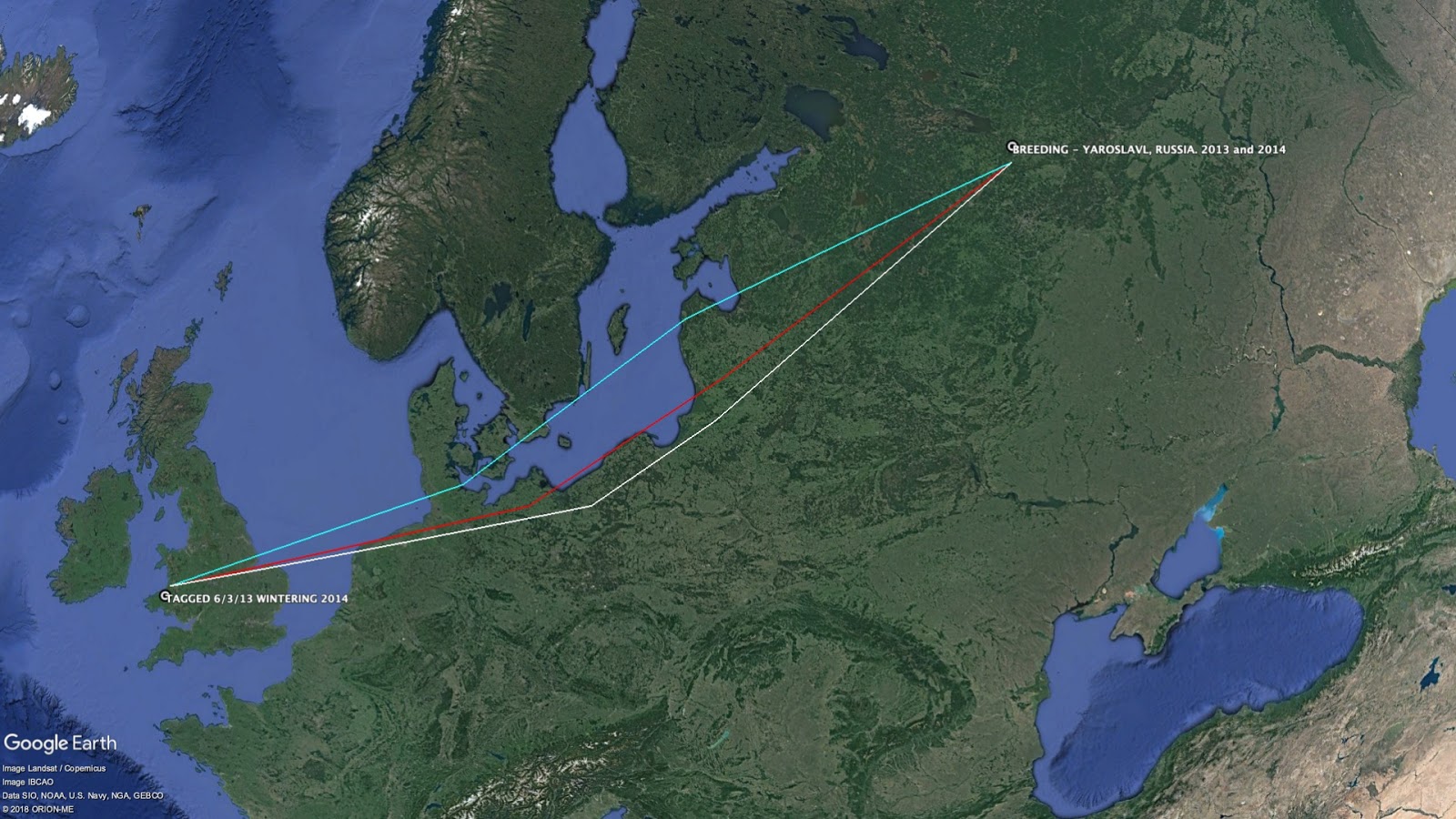
Woodcock migration tracked
We can only speculate how this Woodcock perished, however my ringing site is close to a tributary of the Ystwyth River that enters Cardigan Bay 9 km away and very close to the beach in Aberystwyth where the tag was found. There is no knowing when it perished, but it does appear that this tag has spent a considerable time immersed in water. The fact that the data was still accessible after all this time speaks volumes about the quality of design and engineering that goes into these tags.

02 August 2016

Want to see a Whimbrel? Den mark it with a colour ring

It's always a pleasure to hear the Whimbrel's distinctive call when flying over and it's very special when one is caught (see online reports). Relatively few are ringed in Britain & Ireland and with the addition of colour rings the reporting rate has increased substantially. The pie chart below shows how few dead birds are found in relation to the number of reports received of colour rings.


The Mid Wales Ringing Group started a colour ringing project in 2010 to try to answer some basic questions regarding Welsh birds in particular, like movements, staging areas, survival and site faithfulness. Some of these birds have been reported (dead and alive) in quite a few areas including Scotland, France and North Africa.

A Whimbrel wearing a Mid Wales colour-ring combination was recently reported in Denmark. The BTO online reports show this to be only the fourth BTO-ringed Whimbrel to be reported in Denmark. Yellow D74 was ringed on 30 April 2016 at 2:50 am and 72 days later it had travelled a minimum distance of 1,059 km to Storevorde, Denmark.

If you were hoping to see a BTO-ringed Whimbrel outside Britain & Ireland, there is a much greater chance of seeing one in Guinea (195 reports), Guinea Bissau (224 reports) and Iceland (366 reports).


Colour-ringed Whimbrel photo taken by Jens Veilgaard Vendelbo
Whimbrel photo taken by Jens Veilgaard Vendelbo

So if you ever see a Whimbrel, or any other wild bird for that matter, report it at www.ring.ac. The information will be very useful and could hint towards a new movement or behaviour.

For more information on this and other Mid Wales goings on, click here.

06 January 2015

Fall-ing for Woodcock

On a very cold and snowy morning early in the New Year Rachael and I joined Tony Cross, one of the founding members of the Woodcock Network, on one of his many nocturnal winter forays into the hills of Shropshire and Mid-Wales. Formed in 2008 to increase the study of this elusive but surprisingly numerous nocturnal wader, the Woodcock Network has managed to increase the annual total of Woodcock ringed in the UK from just 80 in 2007 to over 1,377 in 2013. This has been achieved by encouraging a growing number of ringers to give the ‘dazzle and net’ technique a go. Those who have done so have quickly discovered that this under-researched species offers rich rewards for anyone prepared to brave the wet and windy nights of winter. Mid Wales ringers alone ringed exactly 500 Woodcock in 2014 and Tony recently had a record catch of 27 Woodcock in one night.

Woodcock - Tony Cross

As it turns out we chose quite a memorable occasion to tag along. The first bird we caught, and Tony’s first bird handled in 2015, was the Network’s first ever control of a foreign ringed Woodcock, - originally ringed in Latvia on 27/10/2012 at Pape, Rucava 56'10N 21 01E (see Tony's blog) 1,600km away. Most foreign ring recoveries we process are from birds that have been shot but with a growing number of ringers now focusing on Woodcock in France, Russia, Italy and Spain the chances of capturing a foreign-ringed bird is set to increase each year.  Woodcock ringers in the UK have also enjoyed a regular stream of recoveries from far-flung locations such as Ireland, Spain, France, Holland, Germany, Norway, Denmark, Sweden, Finland and Russia.


The Latvian ringed Woodcock

Since being trained to ring Woodcock by Tony in 2008, Owen Williams, director of the Network, has concentrated his ringing efforts on a site near Aberystwyth in West Wales on which he has caught over 700 Woodcock. This has revealed some fascinating details on wintering site fidelity. For example in the winter of 2012/13 out of 85 adults caught on the site an amazing 47% were birds he had ringed in previous winters. Not bad considering that there are no resident Woodcock in this part of the country!

Typical Woodcock habitat found in Mid Wales

The Woodcock Network works closely with Andrew Hoodless of the Game and Wildlife Conservation Trust (GWCT), an organization that has researched Woodcock for many years. The biometric data, counts and observations, which are shared with GWCT, have made a significant contribution to learning more about this species. The Network has also funded a number of geolocators to add to those being fitted to Woodcock by GWCT as part of a project to research their migration.

As the Woodcock is a quarry species shot in the UK it is vitally important that the results of this research are communicated effectively to shooters in order to encourage sustainable hunting. Both the Woodcock Network and GWCT, who are part funded by the shooting community, do this through articles in the shooting press and at numerous talks around the country.

Anyone wishing to know more about how to get involved in Woodcock ringing should contact Owen on 01974 272654 or Tony on 01597 824389.

Thanks to Owen and Tony for all of the information in this post.

30 June 2011

Chough ringing in Wales celebrates 20th Birthday

Little did Tony Cross know when he first started colour ringing Welsh Choughs in 1991 that he would still be doing it 20 years later…

Between himself and project partner Adrienne Stratford, they have colour-ringed more than 4000 pulli as well as about 120 adult Chough, with over 20,000 resightings of colour-ringed individuals during that time.


A bucket of Chough by Kelvin Jones


“When we started the project, it was widely thought that the inland and coastal populations were completely separate, but we now know that they are part of the same population. It is apparent that they need good foraging habitats to be maintained in both coastal and inland mountain areas, as the same birds use both areas at different times of year and stages of their lives, with a lot of youngsters from all areas gathering into “youth-club” flocks in the mountains during their first and second autumns.”

Individual colour marking has allowed Tony and Adrienne to build an intricate picture of the birds’ social lives, breeding biology, movements and land use preferences. Currently, the oldest breeding Chough is 17 years old. In 2004, a flock of about 12 birds left Anglesey and went to the Isle of Man, three of these birds subsequently came back to the mainland, of which two are now part of the Anglesey breeding population.

During the intervening years, they have charted the fortunes of this iconic bird, its disappearance from most of inland mid-Wales, increases in some coastal areas, and recently, worrying signs of decline in inland Snowdonia, probably linked to reduction in grazing of upland pastures due to changes in agricultural subsidies.